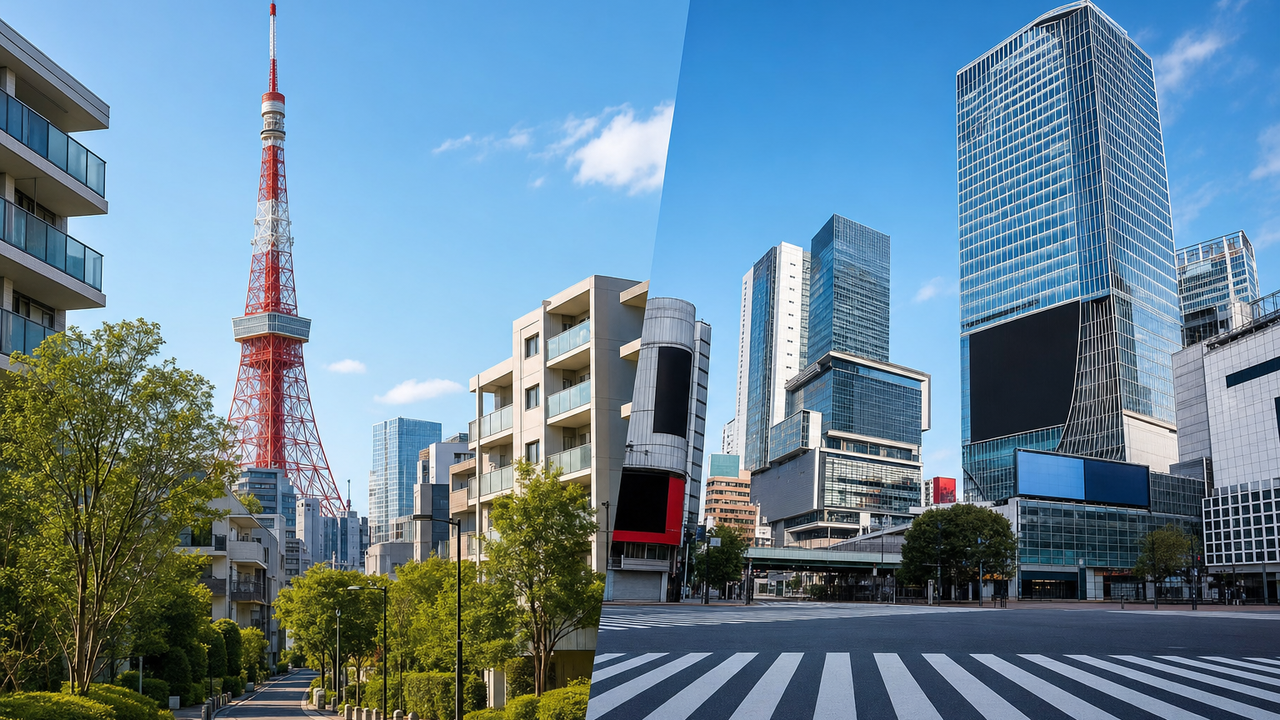
If you’re weighing up Minato versus Shibuya as your next base in Tokyo, you’re not alone — and the decision is far less straightforward than most relocation guides suggest. Both wards sit within easy reach of Shibuya’s tech hubs, both offer internationally oriented living environments, and both command premium rents that reflect their desirability. Yet the day-to-day experience of living in each ward can feel worlds apart, and making the wrong call at the start of a multi-year assignment is a costly mistake that bilingual consultants see regularly.
This article draws on 25 years of residential rental data patterns, lifestyle research, and on-the-ground knowledge of the Jonan area to give foreign professionals in their 20s to 40s a genuinely useful framework for this decision. Rather than recycling generic neighbourhood summaries, we break down the five dimensions that matter most to expats — rent trajectory, commute reality, English-language infrastructure, community character, and long-term livability — so you can match the right ward to your actual lifestyle priorities.
Who this article is for
- Foreign professionals working in or around Shibuya who are choosing between Minato and Shibuya wards for their next rental
- Expats on multi-year contracts who want to understand how each ward has evolved over the past two decades, not just current snapshot data
- Singles and childless couples earning ¥10 million or more annually who are willing to prioritise quality of life over proximity alone
What you’ll learn
- How Minato and Shibuya ward rents, commute times, and lifestyle costs have shifted over a 25-year horizon
- Which ward suits which expat persona based on work style, social priorities, and long-term plans
- The most common regrets long-term foreign residents report — and how to avoid them
Minato vs Shibuya: 5 Key Differences Expats Actually Notice

Most online comparisons stop at average rent and train access. The five differences below go deeper — they reflect what foreign residents consistently report after living in each ward for a year or more.
Neighbourhood Character and Social Atmosphere
Minato ward feels international by design; Shibuya ward feels international by accident — and that distinction shapes daily life significantly. Minato’s high concentration of foreign embassies, multinational headquarters, and long-established expat communities in areas like Azabu-Juban, Hiroo, and Shiba-Koen has produced a neighbourhood infrastructure explicitly built around globally mobile residents. Supermarkets stock imported goods as a matter of course. English-language signage appears without novelty. Medical clinics with English-speaking staff are clustered rather than scattered.
Shibuya ward, by contrast, earns its international flavour from the density of creative industries, technology companies, and younger global talent concentrated in areas like Daikanyama, Nakameguro, and Ebisu. The social scene is vibrant and diverse, but the underlying infrastructure was built for Japanese residents first. English support is improving steadily, but it requires more active navigation than in Minato.
| Minato Ward — Strengths | Minato Ward — Trade-offs |
|---|---|
|
|
Transport Connectivity to Shibuya
Commute time from Minato ward to Shibuya station ranges from approximately 12 to 25 minutes depending on which sub-area you’re in, with Roppongi and Hiroo residents typically relying on the Hibiya Line or bus connections rather than direct rail. Shibuya ward residents, depending on the exact neighbourhood, may walk or cycle to Shibuya station entirely, or use one stop on the Tokyu or Keio lines.
This matters more than it appears on paper. When you live within a 15-minute walk of your workplace, the quality of your morning changes fundamentally — you gain back roughly 30 to 60 minutes of personal time daily, which over a year compounds into weeks. For Minato residents, the commute is comfortable by Tokyo standards, but it exists. For residents of central Shibuya ward neighbourhoods like Daikanyama or Sarugaku-cho, the commute is sometimes optional.
It is also worth noting that Minato ward has exceptional connectivity to the rest of Tokyo — the ward is served by the Yamanote Line, Namboku Line, Mita Line, Asakusa Line, Rinkai Line, and multiple express routes — making it a strong choice for professionals whose work takes them across the city rather than anchoring them solely in Shibuya.
English-Language Services and Daily Life Navigation
For expats navigating Japan without native Japanese reading ability, the availability of English-language daily services is not a luxury — it is a practical quality-of-life variable. Minato ward has historically led among Tokyo’s 23 wards in English administrative support, a product of its long history hosting foreign residents and diplomatic communities. Ward office procedures, local medical care, and even some childcare registration processes have English-language guidance available more consistently in Minato than elsewhere.
Shibuya ward has invested significantly in English-language resident support over the past decade, and the ward office now offers multilingual guidance for most standard procedures. However, the depth and consistency of English support at the neighbourhood level — local clinics, specialist services, community notice boards — still lags behind Minato in many sub-areas. Residents in Nakameguro or Daikanyama often report a need to maintain enough Japanese to handle day-to-day interactions, or to rely on services like bilingual real estate consultants and concierge-style support more consistently.
Lifestyle Cost Beyond Rent
Rent is the headline number, but total lifestyle cost in these two wards diverges in ways that rent comparisons alone don’t capture. Minato’s Azabu and Hiroo areas are anchored by international supermarkets — National Azabu, Hiroo Supermarket, and similar — where imported goods are readily available but priced at a meaningful premium over Japanese-oriented alternatives. A weekly grocery shop for one person can run ¥8,000 to ¥15,000 depending on dietary preferences, compared to ¥5,000 to ¥10,000 in Shibuya ward’s more varied retail landscape.
Dining costs are high in both wards — both rank among Tokyo’s most expensive for restaurants — but Shibuya ward offers a wider range of price points in its neighbourhood dining scene. Nakameguro and Daikanyama have developed densely along the canal with cafes, wine bars, and neighbourhood restaurants that mix affordable and premium options in a way that Minato’s more formal restaurant culture doesn’t always replicate.
Long-Term Neighbourhood Evolution and Stability
Over a 25-year horizon, both wards have appreciated in desirability, but the nature of that change differs. Minato has remained consistently premium — a ward where rental prices and property values have been relatively stable at the top of the Tokyo market, with the composition of its foreign resident community remaining broadly similar. It has not gentrified because it was never affordable to begin with.
Shibuya ward’s transformation has been more dramatic. Areas like Daikanyama and Nakameguro, which were established but niche destinations in the early 2000s, have become among Tokyo’s most internationally recognised lifestyle neighbourhoods over the past two decades. This has brought rising rents, increased competition for quality units, and a more transient population mix — but also a level of neighbourhood investment and renewal that has made the ward more dynamic. For expats interested in Nakameguro specifically, this trajectory is worth understanding in depth.
Housing Costs and Commute: A 25-Year Trend Comparison

Understanding how both wards have moved over time — not just where they sit today — helps expats make a more durable decision. The following analysis reflects general market trends and directional patterns observed over approximately 25 years of Tokyo’s residential rental market. Specific figures represent ranges and tendencies rather than certified data points; for precise current rental rates, consulting a specialist with live market access is advisable.
Rental Price Ranges: Then and Now
Minato ward has consistently commanded the highest average rents among Tokyo’s 23 wards, a position it has held throughout the past quarter century. For a 1LDK or 2LDK apartment suitable for a single professional or couple, rents in prime Minato sub-areas such as Hiroo, Azabu-Juban, and Shirokanedai have generally ranged from the upper ¥200,000s to ¥400,000 or more per month for well-appointed units, with significant variation by building age, floor, and specific location. This is a general tendency rather than a precise figure, and the market has seen meaningful upward pressure since 2022 in particular as overseas interest in Tokyo real estate has grown.
Shibuya ward’s rental market, while premium, has historically offered a slightly wider range of options. Comparable 1LDK to 2LDK units in desirable Shibuya ward sub-areas like Daikanyama, Ebisu, and Nakameguro have tended to run from the mid ¥200,000s into the ¥350,000-plus range for high-quality units. The gap between the two wards’ averages has narrowed over the past decade as Shibuya ward’s desirability has risen, but Minato continues to sit at or above Shibuya for like-for-like unit comparisons in most sub-areas.
For expats arriving from major global cities — London, New York, Singapore, Sydney — both wards will register as expensive but not shocking. The relevant comparison is value for money against lifestyle return, not absolute price.
Commute Reality: Time, Comfort, and Flexibility
Commute data from Minato to Shibuya varies significantly by starting point. Residents of Hiroo or Ebisu (the Shibuya ward side of the Hibiya Line’s Minato corridor) can reach Shibuya station in 10 to 15 minutes with a single line. Residents of Azabu-Juban or Roppongi face a two-step journey — typically Namboku or Oedo Line to a transfer point, then onward to Shibuya — adding 5 to 15 minutes and a transfer. The Roppongi to Shibuya commute via the Hibiya Line’s Roppongi station, transferring at Naka-Meguro for the Tokyu Toyoko Line, illustrates the kind of route planning that Minato residents learn quickly.
Shibuya ward residents, by contrast, typically enjoy direct access to Shibuya station or a very short journey. The Tokyu Toyoko and Den-en-toshi lines, Keio Inokashira Line, JR Yamanote Line, and Tokyo Metro Ginza, Fukutoshin, and Hanzomon lines all converge at or near Shibuya, making the ward exceptionally well-connected by any standard. For professionals who travel frequently within Tokyo — meeting clients in Marunouchi, attending events in Roppongi, visiting offices in Shinjuku — the expat-friendly areas within Shibuya ward offer route flexibility that matches or exceeds Minato for Shibuya-centric commuters specifically. For more on the train line options, the Toyoko Line vs Den-en-toshi Line comparison is a useful reference.
The Hidden Cost of the Wrong Commute
One pattern that emerges consistently in long-term expat feedback is the underestimation of commute friction at the time of signing a lease. A 25-minute door-to-door journey feels comfortable in April; it feels like a burden by January when rain, crowds, and longer working hours compress available personal time. Expats who prioritise living within walking or cycling distance of their Shibuya-area workplace — even at the cost of a smaller apartment or a less prestigious sub-area — tend to report higher overall satisfaction at the 12-month mark than those who optimise for apartment quality and accept a longer commute.
This is not a universal finding, and it depends heavily on work style, remote flexibility, and personal temperament. However, it is a consideration worth stress-testing before committing to a Minato address that requires a daily train journey.
Which Ward Suits Which Expat? A Persona-Based Guide

Rather than declaring one ward objectively superior, the most honest framework is to identify which ward fits which type of person. The following profiles are drawn from patterns observed across years of foreign resident consultation in the Jonan and central Tokyo areas.
The Profile That Tends to Choose Minato
Expats who settle in Minato ward and stay there tend to share several characteristics. They are typically in senior or executive roles — country managers, regional directors, or senior individual contributors — for whom the established international character of areas like Hiroo and Azabu-Juban is not a luxury but an environment that reduces daily friction in a meaningful way. Having English-speaking medical care, international school proximity (even without immediate need), and a neighbourhood that has been hosting foreign residents for decades creates a baseline comfort that professionals on demanding schedules particularly value.
This profile also tends to travel across Tokyo regularly rather than being anchored to Shibuya exclusively. Minato’s exceptional subway connectivity — multiple major lines running through the ward — means that business meetings in Marunouchi, Shinjuku, or Roppongi are equally accessible without the commute trade-off feeling acute. If your working life requires you to be multiple places across central Tokyo in a given week, Minato’s location makes sense in a way that a Shibuya-ward address optimised purely for the Shibuya commute may not.
- Senior professionals on multi-year assignments who prioritise a proven expat infrastructure
- Those who regularly travel across Tokyo for work and need strong subway connectivity in all directions
- Expats for whom English-language daily services (medical, administrative, retail) are a non-negotiable baseline
The Profile That Tends to Choose Shibuya Ward
Shibuya ward tends to attract expats who are earlier in their Tokyo experience — not necessarily younger in age, but at a stage where maximising the energy and novelty of living in one of the world’s most interesting cities takes priority over infrastructure stability. Tech professionals working at companies like Google, ByteDance, or Shibuya-area startups who can cycle to the office on a clear morning and walk home through the Meguro River on a Friday evening are, according to long-term observation, among the happiest expat residents in Tokyo.
The social environment in Daikanyama, Nakameguro, and Ebisu — which sits at the Shibuya ward–Minato ward boundary — is dense with high-quality cafes, wine bars, independent restaurants, and creative spaces that have become internationally known over the past two decades. For singles or couples without children who want their neighbourhood to feel like something worth stepping outside for every day, Shibuya ward consistently delivers this in a way that the more residential and formally oriented parts of Minato do not. The walkability factor for tech workers near Shibuya is a genuine quality-of-life differentiator that is easy to underweight when choosing from abroad.
- Tech and creative professionals whose workplace is within the Shibuya area and who value walk or cycle commute access
- Singles or childless couples prioritising neighbourhood energy, dining variety, and social vibrancy
- Those on 1–2 year contracts who want to maximise the Tokyo experience rather than settle into stability
The Ebisu-Daikanyama Overlap Zone
One fact that many expat comparisons miss is that the Ebisu and Daikanyama areas — among the most desirable residential locations in greater Shibuya — straddle the boundary between Shibuya ward and Minato ward in ways that matter on the ground. Ebisu station technically sits in Shibuya ward, but the residential fabric south and east of it bleeds into Minato’s Shirokanedai and Hiroo neighbourhoods seamlessly. An expat renting in Ebisu gets many of the lifestyle benefits associated with Shibuya ward’s energy while being a short walk from Minato’s established international infrastructure.
This overlap zone is worth exploring explicitly with a bilingual consultant who knows the boundary-area inventory well, because it represents a genuine best-of-both answer for some expat profiles — particularly those who want the neighbourhood character of Daikanyama or Nakameguro but prefer a slightly quieter street and proximity to Hiroo’s international supermarkets and clinics.
Long-Term Regrets: What Expats Wish They’d Known Earlier

After years of supporting foreign residents through the Tokyo rental process and their subsequent experience of living here, certain patterns of regret emerge consistently. Understanding these in advance can meaningfully improve the quality of your decision.
Optimising for the Apartment Over the Neighbourhood
The most common regret reported by expats who chose Minato for a first Tokyo posting is having selected the apartment rather than the neighbourhood. Minato’s reputation pulls strongly, and the apartment stock in areas like Azabu-Juban or Motoazabu is genuinely impressive — high-floor units with city views, concierge-serviced buildings, spacious layouts by Tokyo standards. But an expat who spends 12 hours a day at an office in Shibuya and returns to a beautifully appointed flat in an area where they don’t naturally walk, eat, or socialise often discovers that the apartment’s quality doesn’t compensate for the neighbourhood’s mismatch with their lifestyle.
The inverse regret appears in Shibuya ward: expats who chose a vibrant Nakameguro address and found, after six months, that the apartment itself — typically smaller and older for the same rent as a Minato equivalent — was creating daily frustration that the lively street scene couldn’t offset. Both errors are navigable with better information at the decision stage.
- Signing a lease based on virtual tours and reputation alone, without walking the neighbourhood at different times of day
- Underestimating the Japanese-language barrier for day-to-day services outside the main expat zones
- Assuming the commute will feel the same in winter rain and summer heat as it did on the day you viewed the apartment
- Choosing a neighbourhood for its social reputation without verifying that your specific social preferences — quiet wine bars vs. izakaya clusters, morning runners vs. late-night culture — are well-served there
Misjudging the Japanese Administrative Learning Curve
Expats who arrive in Tokyo without Japanese language ability — a common situation for professionals posted directly from overseas — sometimes underestimate how much the administrative environment affects daily quality of life. Even in Minato, which has the best English administrative support among Tokyo’s wards, interactions with local government, healthcare, and neighbourhood services frequently require patience and, in many cases, bilingual assistance.
The practical implication is that choosing a neighbourhood for its convenience to daily life in English is a legitimate and defensible priority, not an admission of linguistic laziness. Minato’s advantage in this dimension is real and substantive, particularly for expats arriving without a company relocation team or spouse who has navigated the Japanese system before. Conversely, expats with functional Japanese ability — even conversational level — unlock a much wider range of neighbourhood options in Shibuya ward and beyond without sacrificing daily comfort.
Locking Into a Lease Without Understanding the Jonan Alternative
A third regret that appears specifically among expats who chose between Minato and Shibuya without broader exposure is discovering the Jonan area — Meguro, Setagaya, Shinagawa — only after signing a two-year lease. Neighbourhoods like Gotanda, Nakameguro’s quieter residential hinterland, or the Setagaya family of residential areas along the Tokyu lines offer exceptional quality of life, shorter effective commutes in some cases, and meaningfully lower rents than either Minato or central Shibuya ward.
An expat working in Shibuya who lives in Gotanda, for example, has a 10-minute train journey, a neighbourhood that balances practicality with genuine dining culture, and rent that may be 20 to 30 percent below comparable square footage in Hiroo or Daikanyama. The Gotanda area guide for foreign residents covers this in detail. Understanding the full Jonan area before narrowing to Minato or Shibuya is a step that bilingual consultants strongly recommend for any expat who hasn’t yet signed.
Final Verdict: Which Ward Should You Choose?
The honest answer is that neither ward is universally better — but one is almost certainly a better fit for your specific combination of work situation, lifestyle priorities, and tenancy horizon. The framework below distils the decision into actionable form.
Choose Minato If Your Profile Matches This
Minato ward is the stronger choice for expats who are in senior roles, on multi-year assignments, or for whom the reliability of English-language daily services is a genuine daily priority rather than a nice-to-have. If you travel across Tokyo regularly for work, if you want to be in a neighbourhood that has been genuinely internationally oriented for decades rather than recently gentrified, and if you’re prepared to pay a premium that reflects both the quality of the housing stock and the neighbourhood’s built-in expat infrastructure, Minato is a defensible and often excellent choice.
The caveat is that Minato rewards the profile it’s built for. It is not the right ward for someone who wants to feel embedded in Tokyo’s creative energy, who prioritises walking everywhere, or who will feel isolated by a neighbourhood that skews older and more formally residential than the Shibuya end of the spectrum.
Choose Shibuya Ward If Your Profile Matches This
Shibuya ward is the stronger choice for tech professionals, creative industry workers, and expats in their first or second Tokyo posting who want to extract maximum lifestyle value from the city. If your office is in or near Shibuya, if you want to cycle or walk to work on good days, and if neighbourhood energy — restaurants, cafes, the canal at Nakameguro, the independent retail scene at Daikanyama — is a genuine part of what makes life in Tokyo worth it for you, Shibuya ward is a natural home.
The caveat here is physical: apartment quality for the rent is lower than Minato on average, and English-language administrative support is improving but not yet at Minato’s level. These are navigable trade-offs for most expat profiles, but they are real and worth factoring into the decision.
- You’re comparing Minato, Shibuya, and Jonan-area options and need expert guidance in English
- You want to search available units by area and line with bilingual support from start to finish
- You’d benefit from 25 years of Tokyo residential market knowledge before committing to a lease
About the consultation process
Frequently Asked Questions
Is Minato ward significantly more expensive than Shibuya ward for renters?
Generally speaking, Minato ward commands higher average rents than Shibuya ward for comparable unit types, though the gap has narrowed over the past decade as Shibuya ward’s desirability — particularly in Daikanyama, Nakameguro, and Ebisu — has risen substantially. Both wards are among Tokyo’s most expensive for renters, and both are well above the Tokyo average. The practical difference for an expat on a ¥10 million-plus salary is likely to be in the range of ¥30,000 to ¥80,000 per month for a comparable 1LDK or 2LDK, depending on the specific sub-area and building. This is a general tendency based on observed market patterns; current rates vary and should be verified with a bilingual specialist who has live inventory access. Real estate market conditions carry variability and past trends do not guarantee future pricing. We recommend consulting a specialist before making any tenancy decision.
Which ward has better English-language support for day-to-day life?
Minato ward has historically led among Tokyo’s 23 wards for the depth and consistency of English-language services at the neighbourhood level — a product of its long history hosting foreign embassies, multinational headquarters, and an established expat community in areas like Hiroo and Azabu-Juban. English-speaking medical clinics, international supermarkets, and ward office multilingual support are more consistently available and concentrated in Minato. Shibuya ward has invested significantly in multilingual resident services and continues to improve, but the neighbourhood-level English infrastructure remains less comprehensive than Minato’s in most sub-areas. For expats without functional Japanese ability, this is a meaningful practical difference.
Can a foreign national without a guarantor rent an apartment in either ward?
Yes, though the process requires preparation. Japan’s residential rental market has historically required a Japanese guarantor, but the system has evolved significantly — most major buildings now accept institutional guarantor companies (保証会社, hoshō gaisha) in place of a personal guarantor. For foreign nationals, the key requirements are typically proof of income, a valid visa with sufficient remaining period, and a completed application in Japanese. Working with a bilingual consultant — particularly one with 25 years of experience navigating this process for foreign residents — substantially reduces the friction and improves the likelihood of a successful application. Balleggs Global specialises in exactly this process.
Are there good options between Minato and Shibuya — areas that offer elements of both?
Yes, and this is one of the most useful things a local specialist can surface. The Ebisu and Daikanyama areas straddle the Shibuya ward–Minato ward boundary in a way that gives residents access to the neighbourhood energy of Daikanyama while being a short walk from Minato’s Hiroo international infrastructure. The broader Jonan area — Meguro, Shinagawa, and Setagaya — also offers compelling alternatives for Shibuya commuters who want more space, lower rents, or a different residential character. Exploring the full range of options before narrowing to one ward is a step that experienced bilingual consultants strongly recommend. Comparing the Toyoko and Den-en-toshi line corridors, for example, opens up a much wider range of viable neighbourhoods for Shibuya-based professionals.
How long does it typically take to find and secure an apartment in these areas as a foreign national?
The process from initial search to contract signing typically takes two to six weeks for foreign nationals in central Tokyo, though this varies depending on how quickly available units that match your criteria appear in inventory and how quickly you can move through the application process. High-demand units in areas like Hiroo, Azabu-Juban, Daikanyama, and Nakameguro can move very quickly — in some cases within days of listing. Starting the search process at least four to six weeks before your target move date, and working with a bilingual consultant who can alert you to suitable listings and expedite the application process, meaningfully improves the outcome. Remote consultation and online search by area and line are available through services like Balleggs Global.


