If you’re a software engineer at Google, ByteDance, or one of Shibuya’s fast-growing tech startups, finding the right neighborhood in Tokyo can feel overwhelming — especially when most rental guidance is written in Japanese, for Japanese applicants, with Japanese landlords in mind.
This guide cuts through that noise. Based on what foreign tech professionals actually prioritize — commute time to Shibuya or Roppongi, English-speaking property support, walkable amenities, and apartments that accept international applicants — we’ve mapped out the neighborhoods where engineers at major Tokyo tech firms are choosing to live in 2026.
Who this article is for
- Software engineers, product managers, and data scientists relocating to Tokyo for Google, ByteDance, or a Shibuya-based tech company
- Foreign professionals earning ¥10M+ annually who want a neighborhood that matches their lifestyle, not just their commute
- Tech expats navigating the Tokyo rental market without Japanese language support
What you’ll learn
- Which neighborhoods in the Jonan area tech workers actually prefer, and why
- How to compare areas by commute, rent, and English-friendly infrastructure
- What to expect from the rental process as a foreign national in Tokyo
Why Tech Workers Cluster in Tokyo’s Jonan Area
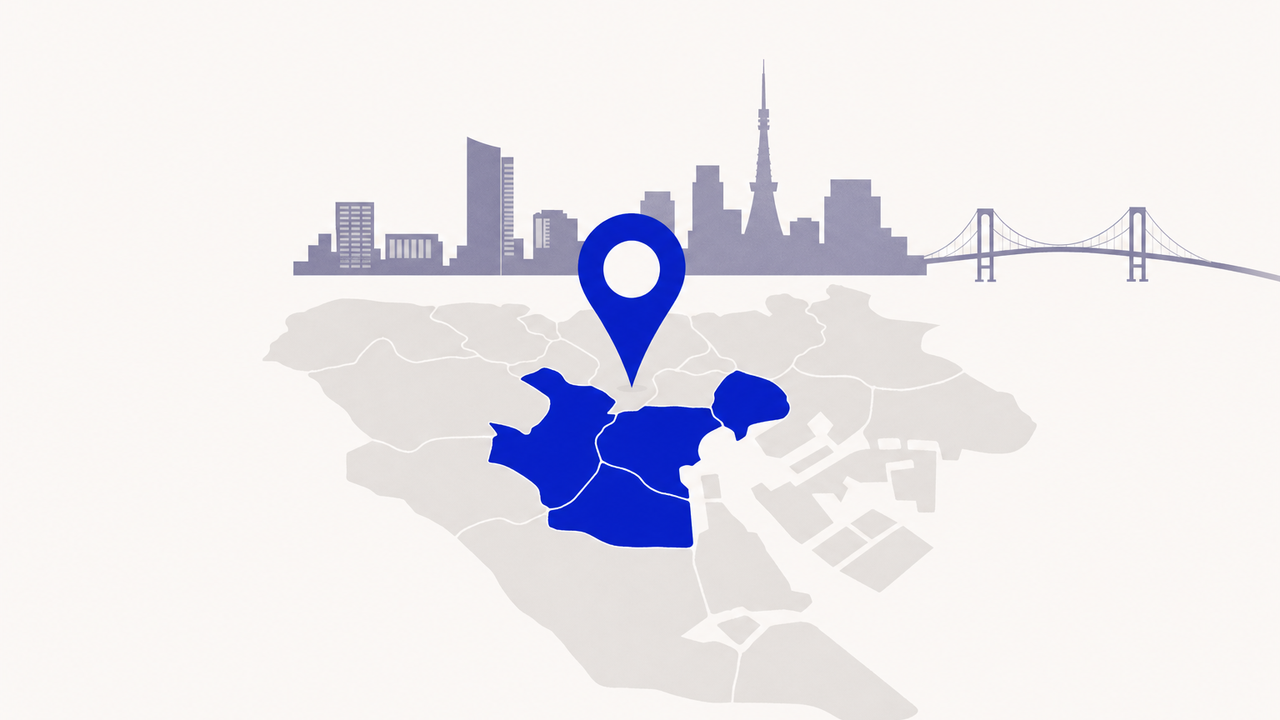
The Jonan area — covering Shibuya, Meguro, Setagaya, Minato, Shinagawa, and Ota wards — has become the default residential zone for foreign tech professionals working in Tokyo. The reason is structural: Google Japan’s office sits in Roppongi Hills (Minato Ward), ByteDance’s Tokyo operation is based near Shibuya, and a dense cluster of funded startups occupies the Shibuya-to-Daikanyama corridor. Living within this zone means a commute measured in minutes, not transfers.
The commute math that shapes neighborhood choice
For engineers who value uninterrupted deep-work time, the commute is a productivity variable. The sweet spot most tech workers report is under 20 minutes door-to-door, which rules out much of western Tokyo and makes the Jonan corridor — roughly Daikanyama to Jiyugaoka — the natural search radius. Neighborhoods like Nakameguro and Ebisu sit within 10–15 minutes of both Shibuya and Roppongi, making them particularly attractive for engineers who split their week between offices. The Tokyu Toyoko Line and the Hibiya Line create a web of fast, uncrowded connections that most tech expats quickly learn to rely on.
Why English infrastructure matters more than it used to
In 2026, English-language support in the Jonan area has meaningfully improved, but it remains uneven by neighborhood. Areas like Nakameguro, Daikanyama, and Hiroo have the highest density of English-friendly services — from bilingual property consultants to international supermarkets, English-language clinics, and cafés where staff can handle basic requests in English. For a foreign professional arriving without Japanese language skills, this distinction is practical, not cosmetic. Navigating a lease negotiation, a utility setup, or an emergency medical visit in Japanese creates friction that compounds over months.
Rent as a proportion of tech income
Engineers at Google Japan or ByteDance Tokyo typically earn between ¥12M and ¥20M annually at senior levels, which changes how rent math works compared to the broader expat population. Most tech workers in this income range allocate 15–25% of gross income to rent, translating to monthly budgets of ¥150,000–¥400,000 for housing. At those levels, the best-positioned neighborhoods in the Jonan area are well within reach, including 1LDK and 2LDK apartments in Nakameguro, Ebisu, and Hiroo. The constraint is less often budget and more often finding an apartment whose landlord accepts foreign tenants — a structural friction that bilingual agents are specifically equipped to navigate.
Neighborhood-by-Neighborhood Breakdown: Where Tech Engineers Actually Live
We’ve analyzed the residential patterns of foreign tech professionals in the Jonan area to produce a practical comparison across the six neighborhoods most commonly cited. Each area is evaluated on commute, rent range, English infrastructure, and lifestyle fit.
| Neighborhood | Ward | Commute to Shibuya | Commute to Roppongi | 1LDK Rent (est.) | English Infrastructure | Lifestyle Vibe |
|---|---|---|---|---|---|---|
| Nakameguro | Meguro | 8 min (Tokyu Toyoko) | 18 min (Hibiya Line) | ¥180,000–¥280,000 | High | Design-forward, walkable canal district |
| Daikanyama | Shibuya | 5 min (Tokyu Toyoko) | 22 min (subway + walk) | ¥220,000–¥350,000 | High | Boutique, low-rise, international feel |
| Hiroo | Minato | 12 min (Hibiya Line) | 8 min (Hibiya Line) | ¥250,000–¥420,000 | Very High | Established expat enclave, embassies, global grocers |
| Ebisu | Shibuya / Meguro | 5 min (JR Yamanote) | 15 min (subway) | ¥200,000–¥320,000 | High | Upscale residential, excellent dining and retail |
| Jiyugaoka | Meguro / Ota | 22 min (Tokyu Toyoko) | 35 min | ¥130,000–¥210,000 | Moderate | Quiet European-style shopping street, local feel |
| Gotanda | Shinagawa | 10 min (JR Yamanote) | 20 min (subway) | ¥130,000–¥200,000 | Moderate | Practical, up-and-coming, strong value |
Nakameguro: the top pick for engineers who want lifestyle alongside location
Nakameguro is the most consistently cited neighborhood among foreign tech workers in their late 20s and 30s, and the reasons are specific rather than vague. The Meguro River canal creates a walkable, visually distinctive street that functions as both a commute route and a social space. Direct Tokyu Toyoko Line access puts Shibuya at 8 minutes; the Hibiya Line connection at Nakameguro Station reaches Roppongi in around 18 minutes. For engineers splitting their week between ByteDance Shibuya and collaborative meetings in Roppongi, this dual-access profile is difficult to replicate in any other single neighborhood.
Rent for a modern 1LDK in Nakameguro runs approximately ¥180,000–¥280,000 per month depending on building age and floor. English-speaking property support exists, though it requires using a consultant specifically experienced with international applicants — general agencies often lack the landlord relationships needed to approve foreign tenants on newer buildings. For a practical guide to what living here actually looks like day-to-day, see our Nakameguro Living Guide for Expats.
Daikanyama and Ebisu: Shibuya-adjacent with a quieter character
Daikanyama sits 5 minutes from Shibuya by train but feels like a different city — low-rise, boutique-lined streets, a notably international residential community, and some of the best independent cafés in Tokyo. It’s a natural choice for engineers who work at Shibuya-based companies and want to walk or cycle to the office on good-weather days. The trade-off is rent: Daikanyama consistently ranks among the more expensive sub-neighborhoods in the Jonan area, with 1LDK units in newer builds starting around ¥220,000 and reaching ¥350,000+ for anything with a terrace or designer fit-out.
Ebisu, sitting immediately adjacent and straddling the Shibuya-Meguro ward boundary, offers similar lifestyle quality at a slightly broader rent range. The JR Yamanote Line from Ebisu Station is particularly useful for engineers with occasional Shinagawa or Shinjuku commitments. Ebisu Garden Place anchors the neighborhood with a cluster of restaurants, a cinema, and retail that functions as a de facto town center — a convenience that engineers working long hours tend to value when they finally surface at 8pm.
Hiroo: the established expat neighborhood with the deepest English infrastructure
Hiroo is the longest-established international residential neighborhood in Tokyo, anchored by the National Azabu supermarket, a cluster of international schools, and proximity to embassy row. For engineers at Google Japan — whose Roppongi Hills office is 8 minutes away by Hibiya Line — Hiroo combines the shortest effective commute with the most developed English-language services: clinics, dentists, legal advisors, and real estate consultants who specifically handle international clients at volume. Rent reflects this premium positioning, with 1LDK units typically ranging from ¥250,000 to ¥420,000.
The neighborhood skews slightly older in its expat demographic — more finance professionals and longer-term residents than early-career tech workers — but this also means building managers and landlords in Hiroo tend to have more experience with foreign tenants, which translates to smoother application processes. For engineers with families or who prioritize stability and access to international services, Hiroo is frequently the final answer.
How to Choose Your Neighborhood: Five Evaluation Axes for Tech Workers

Choosing a neighborhood in Tokyo involves more variables than commute time alone. The five criteria below are the ones that tech expats consistently report as decisive — in roughly this order of importance.
Commute reliability and multi-office flexibility
The most important factor is not raw commute distance but commute reliability across multiple destinations. Engineers at companies like Google and ByteDance often work across more than one office in a week — the main campus, a co-working venue, a client site — and the neighborhoods that score best are those served by two or more independent train lines. Nakameguro (Tokyu Toyoko + Hibiya), Ebisu (JR Yamanote + Hibiya), and Hiroo (Hibiya) offer different profiles but all provide reasonable access to both the Shibuya corridor and the Roppongi-Azabu corridor without requiring a complex transfer sequence. For a deeper look at which line serves your commute pattern best, our Toyoko Line vs Den-en-toshi Line comparison guide is a useful starting point.
Landlord acceptance of foreign tenants
Approximately 40–60% of standard Tokyo apartment listings from domestic agencies are effectively unavailable to foreign nationals, either because the landlord has an explicit no-foreign-tenant policy or because the guarantor and documentation requirements create practical barriers. This is a structural reality that varies significantly by neighborhood. Areas with longer histories of international residents — Hiroo, Daikanyama, Nakameguro — have higher proportions of landlords and building managers who have processed foreign tenant applications before and are comfortable with the process. Working with a bilingual consultant who maintains direct landlord relationships is the most reliable way to access listings that are genuinely open to international applicants.
English-language daily services
The practical ceiling on a neighborhood’s suitability for a non-Japanese speaker is determined by the depth of its English-language services, not just its general desirability. Hiroo and Daikanyama lead on this dimension: both have international supermarkets, English-speaking medical clinics, bilingual estate agents, and enough resident foreigners that daily life can be navigated primarily in English for the first months while Japanese language skills develop. Nakameguro and Ebisu sit one tier below — English is widely understood in commercial settings, but administrative tasks (utility registration, local government procedures) typically require Japanese or assistance. Jiyugaoka and Gotanda, while excellent value, require more active language navigation for daily life.
Apartment specifications for tech worker lifestyles
Engineers working remotely or on hybrid schedules have specific apartment requirements that differ from the general renter population: reliable high-speed internet (1Gbps fiber is standard in newer Tokyo builds but should be confirmed), a dedicated workspace or second room, air conditioning capacity for year-round operation, and soundproofing adequate for video calls. In the Jonan area, newer builds (post-2015) in Nakameguro, Ebisu, and Daikanyama generally meet these specifications. Older buildings in the same neighborhoods — often priced attractively — may have thinner walls, shared-pipe internet, or older HVAC systems that struggle in summer. Confirming fiber internet availability and room layout before viewing is a step that bilingual consultants typically handle as part of their initial screening.
Walkability and after-work infrastructure
For tech workers with demanding schedules, neighborhood walkability functions as a quality-of-life multiplier: the ability to reach a good restaurant, a gym, a convenience store, or a park within 10 minutes on foot recaptures time that a car-dependent or transit-only lifestyle cannot. Nakameguro, Daikanyama, and Ebisu all score highly on this dimension — each has a dense network of independent restaurants, specialty coffee shops, and fitness facilities within a 10-minute radius of most residential buildings. Hiroo is slightly more spaced out but compensates with the National Azabu supermarket and a quieter park network. For a broader look at which neighborhoods rank best on this specific axis, see our guide to walkable Tokyo neighborhoods for tech workers near Shibuya.
What the Rental Process Actually Looks Like for Foreign Nationals

The Tokyo rental process has specific requirements that catch many foreign professionals off-guard, particularly those relocating from markets where leasing is more straightforward. Understanding the process in advance reduces the chance of losing an apartment you want to a faster-moving applicant.
Documents you’ll need before you start viewing
Having your documents ready before you start viewing apartments is not optional — it is decisive. In Tokyo’s competitive rental market, popular apartments in Nakameguro, Daikanyama, or Ebisu can receive multiple applications within 24–48 hours of listing. Landlords and agencies typically require: a current residence card (zairyu card), an employment certificate from your company on official letterhead (Japanese or bilingual), recent payslips or an employment contract showing annual income, and a contact at your company’s HR or admin function who can respond to verification requests. Engineers relocating from overseas before their visa is issued should coordinate with their employer’s relocation team to have these documents prepared in advance.
The guarantor requirement and how it works
Almost all Tokyo rental apartments require a guarantor (hoshōgaisha) — a licensed guarantee company that co-signs your lease. For foreign nationals, using a domestic guarantor company is the standard approach; relying on an individual Japanese personal guarantor is rarely practical and increasingly uncommon even for Japanese renters. Guarantee fees typically amount to 0.5–1 month’s rent as a one-time cost, plus an annual renewal fee of around ¥10,000–¥20,000. Some guarantee companies have limited experience with foreign applicants and may require additional documentation or a higher initial deposit. Bilingual consultants with established relationships with international-friendly guarantee companies can navigate this step significantly faster. For a full walkthrough of the process, our Complete Foreigner’s Guide to Renting an Apartment in Tokyo covers every stage in detail.
Initial costs: what to budget before you move in
The initial cost of securing an apartment in Tokyo typically runs 4–6 months’ rent as a lump sum, payable before key handover. This breaks down across several line items: a security deposit (shikikin) of 1–2 months’ rent, an agency fee (chūkai tesūryō) of approximately 1 month’s rent plus consumption tax, the guarantor company fee of 0.5–1 month’s rent, and the first month’s rent itself. Some landlords in the Jonan area — particularly for higher-end units — also charge a non-refundable key money (reikin) of 1–2 months, though this practice has become less common in newer buildings. On a ¥250,000/month apartment, a realistic initial outlay is ¥1,000,000–¥1,500,000. This is a cash payment and is not typically covered by company relocation packages unless specifically negotiated.
Persona-Based Recommendations: Which Neighborhood Fits Your Situation
The right neighborhood depends on more than just where your office is. Below are four common tech worker profiles and the neighborhoods that tend to work best for each.
The Google Japan engineer prioritizing Roppongi commute and English services
For engineers whose primary office is Google Japan in Roppongi Hills, Hiroo is the most logical base. The Hibiya Line connection puts Roppongi Station at 8 minutes; English-language services are more developed here than anywhere else in the Jonan area; and the neighborhood’s long history of international residents means landlord acceptance of foreign tenants is higher than the Tokyo average. Budget-conscious engineers in this profile often find Nakameguro a strong alternative — slightly longer commute (18 minutes via Hibiya Line) but meaningfully lower rents and a more energetic neighborhood character.
The ByteDance or startup engineer who cycles to Shibuya
Engineers at ByteDance or Shibuya-based startups who want to minimize commute time and maximize lifestyle quality tend to converge on Daikanyama or Nakameguro. Both neighborhoods are close enough to Shibuya to cycle comfortably in good weather — Daikanyama is approximately 15 minutes by bicycle, Nakameguro around 20. For those who prefer transit, the Tokyu Toyoko Line covers the distance in under 10 minutes. The neighborhood character of both areas suits engineers who want curated, walkable environments — independent coffee shops, design-led restaurants, and a residential density that feels livable rather than overwhelming.
The senior engineer or engineering manager who wants space and quiet
Senior engineers and engineering managers — often earning ¥18M+ and with more flexibility on location — frequently end up in Ebisu or the quieter residential streets of Meguro. Ebisu offers direct JR Yamanote Line access to Shibuya in 5 minutes, a neighborhood character that is upscale without being conspicuous, and a supply of larger 2LDK apartments (¥280,000–¥450,000) that accommodate home office setups more comfortably than the compact 1LDKs common in Nakameguro. Gotanda is worth noting for engineers who want strong value and a slightly longer commute — 10 minutes from Shibuya on the JR Yamanote Line — in a neighborhood that is increasingly attracting tech workers priced out of Ebisu and Nakameguro. Our Gotanda area guide covers what the neighborhood currently offers in practical terms.
The engineer relocating as a couple without children
Couples without children typically weigh neighborhood quality more heavily than school district, which opens up a wider range of options within the Jonan area. Nakameguro and Daikanyama both accommodate couple lifestyles well — the canal area, restaurant density, and weekend-market culture create a shared environment that works for two people rather than one. Jiyugaoka is worth considering for couples who prefer a quieter, slightly more local character and are comfortable with a 22-minute commute to Shibuya; rents there are meaningfully lower (1LDK from approximately ¥130,000) and the neighborhood’s European-influenced shopping street and café culture give it a distinctive character. For a full neighborhood comparison across the Jonan area, our Tokyo neighborhood comparison guide provides a detailed reference.
Summary: Finding Your Base in the Jonan Area
For Google, ByteDance, and tech startup engineers relocating to Tokyo in 2026, the Jonan area remains the most rational residential zone — combining short commutes to the major tech office clusters, the highest concentration of English-language services in the city, and a range of neighborhood characters that match different lifestyle preferences and budget levels.
The neighborhoods that appear most consistently in tech worker decisions are Nakameguro (best all-round balance of commute, lifestyle, and price), Hiroo (strongest English infrastructure and closest to Roppongi), Daikanyama and Ebisu (Shibuya-adjacent with curated residential character), and Gotanda (best value for engineers willing to trade neighborhood prestige for a practical, fast-improving area).
The rental process — particularly the landlord screening and guarantor requirements — remains the structural challenge most foreign nationals underestimate. Working with a bilingual consultant who maintains direct relationships with landlord-accepted listing stock is the most reliable way to shorten the search timeline and avoid the frustration of applying for apartments that were never realistically available to foreign tenants.
- Foreign tech professionals who need English-language support throughout the entire rental process
- Engineers relocating to Tokyo who want access to pre-screened, landlord-approved listings in the Jonan area
- International residents who want 25 years of real-estate consulting expertise behind their property search
About the consultation process
Frequently Asked Questions
Where do most Google Japan engineers live in Tokyo?
Engineers at Google Japan’s Roppongi Hills office tend to concentrate in Hiroo, Nakameguro, and Ebisu — all within 8–18 minutes of Roppongi by Hibiya Line or connecting subway. Hiroo is the longest-established choice and has the deepest English-language services; Nakameguro offers a lower rent range with strong lifestyle quality.
Can foreign nationals easily rent apartments in the Jonan area?
It is possible, but landlord acceptance of foreign tenants varies significantly by building and area. Neighborhoods with longer histories of international residents — Hiroo, Daikanyama, Nakameguro — have higher acceptance rates. Using a bilingual consultant with established landlord relationships is the most effective way to access listings that are genuinely available to foreign applicants.
What is the typical rent for a 1LDK in Nakameguro or Ebisu?
In 2026, a 1LDK in Nakameguro typically ranges from approximately ¥180,000 to ¥280,000 per month depending on building age, floor, and specification. Ebisu runs slightly higher on average, from around ¥200,000 to ¥320,000. Actual rents vary considerably by building — newer builds with fiber internet and updated fixtures tend toward the upper end of these ranges.
How long does the rental process typically take in Tokyo?
From the first property viewing to key handover, the Tokyo rental process typically takes 2–4 weeks when documents are prepared in advance. The guarantor screening stage is often the longest variable. Working with a bilingual consultant who has an established relationship with guarantor companies can compress this timeline. Engineers relocating from overseas should allow additional time for initial document preparation before the search begins.
Is Gotanda a realistic option for tech workers commuting to Shibuya?
Yes. Gotanda is 10 minutes from Shibuya on the JR Yamanote Line, making it a practical and increasingly popular choice for engineers who prioritize value. Rents for 1LDK apartments in Gotanda are generally ¥130,000–¥200,000 — meaningfully below Nakameguro or Ebisu. English infrastructure is more limited than in Hiroo or Daikanyama, but the neighborhood is actively improving and offers good access to both the Shibuya corridor and Shinagawa.