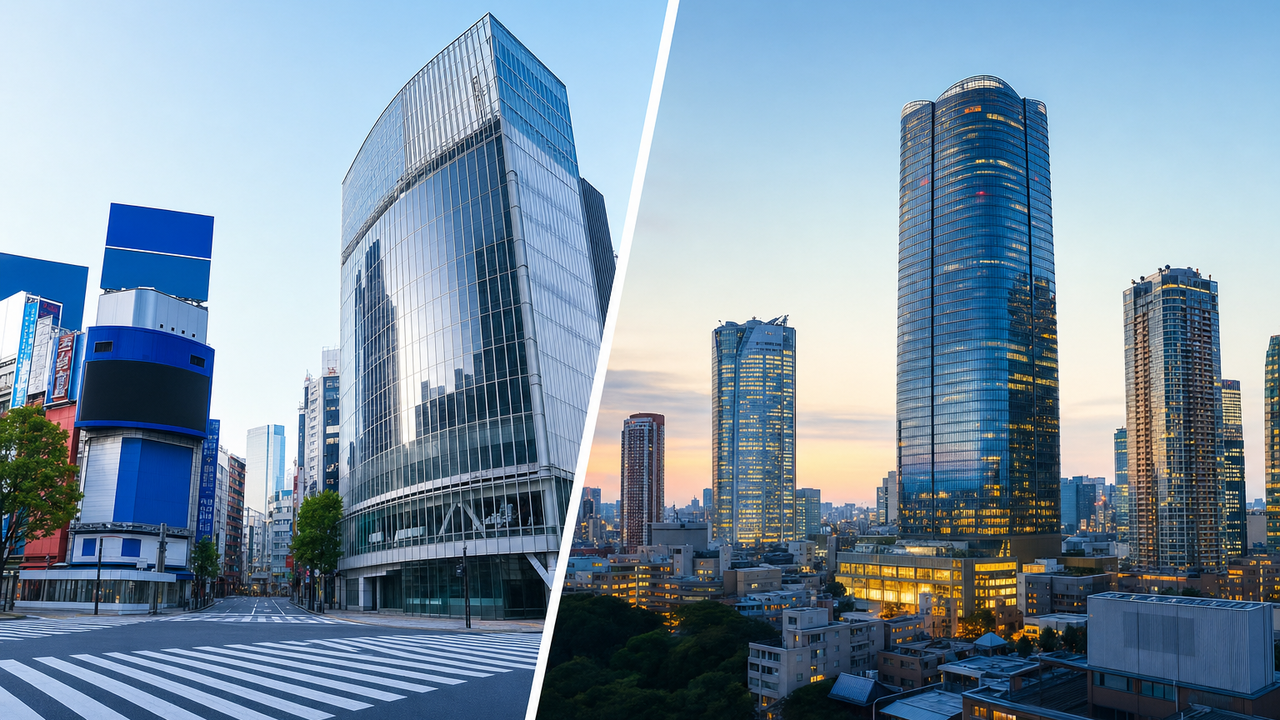
Choosing between Shibuya and Roppongi is one of the most common dilemmas for foreign professionals relocating to Tokyo—and it’s rarely as simple as it looks on a map. Both neighborhoods sit within Tokyo’s prestigious city center, both attract high-earning international residents, and both offer a lifestyle that few cities in the world can match. Yet the day-to-day experience of living in each area is strikingly different, and the wrong choice can quietly drain your energy, budget, and quality of life over months and years.
At Balleggs Global, our bilingual consultants have spent 25 years helping foreign professionals find homes across central Tokyo. Over that time, we’ve gathered candid feedback from hundreds of expat residents who have lived—and in many cases, moved between—both Shibuya and Roppongi. This article distills that resident feedback into an honest, practical comparison so you can make a confident decision before signing a lease.
Who this article is for
- Foreign professionals in their 20s–40s working at companies near Shibuya or Minato-ku
- Expats comparing Shibuya and Roppongi as final candidates before committing to a lease
- High-income singles or couples without children looking for a Tokyo base that fits both work and lifestyle
What you’ll learn
- How Shibuya and Roppongi differ across rent, commute, lifestyle, and community feel
- What long-term residents say about each area after the honeymoon period wears off
- Which neighborhood suits which type of expat professional, based on real consulting experience
What Really Matters When Choosing Between Shibuya and Roppongi

Most expats begin their Tokyo neighborhood search by comparing rent prices or counting English-friendly cafés on Google Maps. Those factors matter, but residents who have lived in both areas consistently say the differences that compound over time are subtler—noise levels after midnight, the walk from the station, whether your neighbors are families or party crowds, and how quickly you can decompress after a long workday.
Rent and What You Actually Get for Your Budget
Both Shibuya and Roppongi command premium rents by Tokyo standards, but the value equation is different. In Shibuya-ku, a well-located 1LDK (one bedroom plus living/dining) in a modern building typically ranges from roughly ¥200,000 to ¥300,000 per month, depending on proximity to the station and building age. In Roppongi and the surrounding Minato-ku addresses, comparable units tend to sit at the upper end of that band or above it, partly because of the concentration of high-specification luxury buildings that cater specifically to diplomatic and corporate expat housing budgets.
Resident feedback collected over our 25 years of consulting consistently highlights one pattern: Roppongi residents often pay a prestige premium that doesn’t always translate into meaningfully larger living space. Several clients who relocated from Roppongi to Shibuya-adjacent neighborhoods reported gaining 15–20 square meters of floor space for the same monthly cost. If your company provides a generous housing allowance tied to a specific area, Roppongi’s luxury stock may be the right fit. If you’re personally managing your budget, the value calculation deserves careful scrutiny.
It’s also worth noting that initial costs in both areas—key money, deposit, agency fees, and guarantor arrangements—can reach two to four months’ rent. Factoring this into a realistic budget comparison before comparing monthly rents is strongly recommended. For a full breakdown of upfront costs, see our guide: The Complete Foreigner’s Guide to Renting an Apartment in Tokyo.
Commute Patterns and Rail Connectivity
Shibuya Station is one of the busiest and best-connected rail hubs in Tokyo, served by the JR Yamanote Line, the Tokyo Metro Ginza, Hanzomon, and Fukutoshin lines, the Tokyu Toyoko Line, and the Tokyu Den-en-toshi Line. For professionals working anywhere on the Yamanote loop or commuting toward Yokohama or Kanagawa, living within walking distance of Shibuya Station is a genuine daily-life advantage.
Roppongi is served by two Metro lines—the Hibiya Line and the Oedo Line—which offer solid connectivity to Marunouchi, Shinjuku, and Shiodome, but the network is notably thinner than Shibuya’s. Residents who work in Shibuya itself often describe the Roppongi-to-Shibuya commute as involving at least one transfer and taking 20–30 minutes. That’s manageable, but it adds up over five years of daily use.
For professionals at Google Japan’s office or similar Shibuya-area tech companies, living near the Tokyu lines offers particularly convenient access. Our area guide on living near the Google Japan office covers the specific train lines and neighborhoods worth considering for that commute.
Lifestyle Environment and Neighborhood Feel After Dark
This is where resident feedback diverges most sharply. Roppongi’s nightlife infrastructure—international clubs, late-night bars, embassy functions, and a high density of foreign nationals—creates an environment that many newly arrived expats find immediately welcoming. The downside, as longer-term residents frequently note, is that the area around Roppongi Crossing does not quiet down. Residents in buildings within 400–500 meters of the main intersection report ambient noise as a persistent background reality, particularly on weekends.
Shibuya has its own energetic character, but the residential fabric of the ward is more layered. Neighborhoods like Daikanyama, Ebisu, and the quieter backstreets of Tomigaya sit within Shibuya-ku yet feel distinctly more residential. Residents who moved from Roppongi to Ebisu frequently describe the transition as trading convenience for a sense of genuine neighborhood belonging. The trade-off is real—Roppongi’s expat social infrastructure is denser—but for residents who prioritize sleep quality, morning runs in a calm environment, and the feeling of living in Tokyo rather than visiting it, Shibuya’s adjacent neighborhoods score meaningfully higher in long-term satisfaction surveys.
Shibuya vs Roppongi: Side-by-Side Comparison
The table below summarizes how Shibuya and Roppongi compare across the five evaluation axes that matter most to foreign professionals in their long-term housing decisions. This framework is based on criteria developed through 25 years of resident feedback and bilingual consulting at Balleggs Global.
| Evaluation Axis | Shibuya (via Balleggs Global) | Roppongi |
|---|---|---|
| Rent Value | Wide range; strong value in Ebisu, Daikanyama, Tomigaya sub-areas | Premium pricing; luxury stock dominates; prestige premium common |
| Rail Connectivity | Excellent — JR, 3 Metro lines, 2 Tokyu lines at one hub | Good — Hibiya & Oedo lines; fewer direct options |
| Lifestyle & Quiet | Layered — energetic core with genuinely residential pockets nearby | Active nightlife scene; less quiet near Roppongi Crossing |
| English-Friendliness | Strong — bilingual services, international supermarkets, expat community | Very high — embassy district, international clubs, English menus universal |
| Long-Term Resident Satisfaction | High — especially for professionals who value work-life separation | High initially; some residents seek quieter areas after 1–2 years |
Shibuya — Honest Resident Review
Shibuya as a neighborhood for foreign residents is best understood as a hub with multiple distinct sub-identities rather than a single homogeneous area. The station surroundings are commercially intense and constantly evolving, but the real draw for long-term expat residents is the quality of life in sub-areas like Ebisu, Daikanyama, and Tomigaya, all of which sit within Shibuya-ku’s administrative boundaries and offer access to Shibuya Station’s rail network without the station’s ambient energy.
Residents who have lived in Shibuya-ku for three or more years frequently describe appreciating the balance: they can be at their desk in a Shibuya tech office within 10–15 minutes on foot, and they can return home to a quiet, tree-lined street where local residents are a mix of Japanese families, young professionals, and a settled international community. The area around Nakameguro—just one stop on the Tokyu Toyoko Line—adds another dimension for residents who want weekend café culture without a train ride into a tourist zone.
| Feature | Assessment |
|---|---|
| Balleggs Global coverage | Full bilingual support for Shibuya-ku properties |
| Rent range (1LDK) | Varies widely by sub-area and building spec; consult for current listings |
| Best for | Tech professionals, Shibuya commuters, lifestyle-focused expats |
| English support level | Strong across the ward; excellent in Ebisu and Daikanyama |
| Long-term satisfaction | High — especially residents who work nearby and value quiet evenings |
One honest note from resident feedback: Shibuya’s construction activity has been significant in recent years as the station area undergoes major redevelopment. Residents in buildings immediately adjacent to Shibuya Station have at times experienced noise from construction schedules. This is worth factoring into building selection, and a bilingual consultant who knows which specific buildings and streets are affected can help you avoid this issue entirely.
- Tech professionals whose office is in or near Shibuya Station (Google Japan, ByteDance, startups in Shibuya Stream or Cerulean Tower area)
- Expats who want a residential neighborhood feel within walking distance of a major rail hub
- Couples or singles who prioritize morning quiet and work-life separation over late-night social proximity
Roppongi — Honest Resident Review
Roppongi’s reputation as the international neighborhood of Tokyo is well-earned and not without substance. The area around Roppongi Hills and Tokyo Midtown hosts some of the city’s most prestigious residential towers, an extraordinary concentration of international restaurants and bars, and a social scene that makes it genuinely easy to build a social life quickly after arriving in Japan. For newly arrived expats navigating Japan without an existing social network, Roppongi’s built-in community infrastructure can be a real advantage in the first six to twelve months.
The honest feedback from longer-term residents, however, adds important nuance. Residents who have spent two or more years in Roppongi—particularly those in the streets immediately around Roppongi Crossing—frequently mention noise, the visibility of late-night street activity near certain venues, and a sense that the neighborhood doesn’t fully quiet down or settle into a residential rhythm in the way that areas like Ebisu or Nakameguro do. Several residents in our consulting history have described their Roppongi experience as “fantastic for the first year, the right call for corporate housing purposes, but not where I’d choose to put down long-term roots.”
| Feature | Assessment |
|---|---|
| Expat social density | Very high — among the highest in all of Tokyo |
| Rent range (1LDK) | Premium to ultra-premium; corporate relocation packages common |
| Best for | Newly arrived expats on corporate packages, diplomatic community, frequent entertainers |
| Nightlife environment | Active through the week; can be loud near Roppongi Crossing |
| Long-term satisfaction | High initially; some residents prefer to relocate after 1–2 years |
It’s important to be precise here: Roppongi is not a monolithic area. The streets around Roppongi Hills (Roppongi 6-chome) and Tokyo Midtown (Akasaka 9-chome) have a distinctly different feel from the area around Roppongi Crossing (Roppongi 3–4-chome). Residents in the Hills and Midtown tower complexes generally report quieter immediate environments, though at correspondingly higher rents. Building selection within Roppongi matters enormously, and this is precisely the kind of local knowledge that 25 years of on-the-ground consulting produces.
- Foreign professionals on company-provided housing packages targeting Minato-ku addresses
- Newly arrived expats who want to build a social network quickly and value proximity to the international community
- Residents whose work involves frequent evening entertaining or whose office is in the Toranomon–Azabudai corridor
Which Neighborhood Should You Choose? A Persona-Based Guide

After 25 years of helping foreign professionals find homes in Tokyo, our consultants have identified clear patterns in which type of expat tends to thrive in each area. Rather than declaring one neighborhood superior, the honest answer is that the right choice depends on your work location, lifestyle priorities, length of stay, and whether your housing is self-funded or company-supported.
For Tech Professionals Based in Shibuya
If your office is in Shibuya—at companies like Google Japan, ByteDance, or in the startup ecosystem around Shibuya Stream and Cerulean Tower—then choosing to live in Shibuya-ku or immediately adjacent areas like Meguro or Ebisu is almost always the higher-satisfaction outcome. The rail connectivity is unmatched, and sub-areas like Nakameguro and Ebisu offer a standard of daily life that residents with a range of lifestyle preferences tend to find deeply satisfying over multi-year stays. The ability to cycle or walk to work—something that genuinely becomes available for some Shibuya-based office locations—is a quality-of-life advantage that Roppongi-based residents rarely experience.
Our guide to walkable Tokyo neighborhoods for tech workers explores this dimension in more depth, including specific street-level mapping of commute times from various Shibuya-adjacent neighborhoods to major tech office locations.
For Expats on Corporate Relocation Packages
If your company’s relocation policy specifies Minato-ku, or if your HR department is working from a pre-approved list of properties that skews toward Roppongi Hills or Tokyo Midtown towers, then Roppongi is likely the practical starting point. In this scenario, the question shifts from “Shibuya or Roppongi?” to “which specific building within Roppongi?” That’s where building-level local knowledge matters: the difference between a unit on a quiet residential street in Roppongi 6-chome and a unit on a busy commercial corridor in Roppongi 3-chome can mean the difference between waking up rested or waking up tired.
Residents on corporate packages who later move to self-funded housing—a common transition after the first contract year—frequently choose to relocate toward Shibuya, Ebisu, or Meguro at that stage. Planning for this transition from the beginning, rather than discovering the preference after the fact, is something our bilingual consultants can help with proactively.
For Residents Prioritizing Long-Term Quality of Life
The clearest signal from long-term resident feedback is this: residents who plan to stay in Tokyo for three or more years, who are self-funding their rent, and who prioritize sleep quality, daily calm, and a sense of genuine neighborhood belonging tend to choose Shibuya-adjacent addresses over Roppongi over time—even when they initially considered Roppongi as a first Tokyo home. This doesn’t make Roppongi a wrong choice for a first year; it makes it a different choice, suited to a different set of priorities and circumstances.
For residents on the Tokyu lines, the comparison between the Toyoko Line and Den-en-toshi Line is also worth understanding, as it shapes which specific neighborhoods become practical based on your office location.
- Foreign professionals who need bilingual support throughout the entire rental process
- Expats comparing final area candidates and wanting honest, experience-based advice rather than a sales pitch
- Residents who want access to curated central Tokyo listings searchable by area and train line online
About our consulting approach
Summary: Shibuya vs Roppongi After 25 Years of Resident Feedback

Both Shibuya and Roppongi are genuinely excellent bases for foreign professionals in Tokyo, and both appear regularly among the neighborhoods our consultants recommend depending on individual circumstances. The honest summary from 25 years of resident feedback is this: Roppongi excels at social infrastructure and immediate expat integration, while Shibuya rewards long-term residents who value rail connectivity, lifestyle variety, and work-life separation.
Neither area is universally better. The right answer depends on where you work, how your housing is funded, how long you plan to stay, and what you need from your home environment after a demanding workday. A bilingual consultant who knows both areas at the street and building level—not just the ward level—can map those variables to specific properties and help you avoid the common mistake of choosing based on neighborhood reputation alone.
If you’re in the final stages of comparing these two neighborhoods and want a straight answer based on your specific situation, the most useful next step is a conversation rather than more research. Our consultants at Balleggs Global handle this kind of comparison daily, entirely in English, with no obligation to proceed.
POINT
Real estate market conditions in Tokyo involve variability and risk. The information in this article reflects general resident experience and consulting observations over time, not guaranteed outcomes. We recommend speaking with a licensed real estate specialist before signing any lease agreement.
Frequently Asked Questions: Shibuya vs Roppongi for Expats
Is Roppongi safe for foreign residents living long-term in Tokyo?
Roppongi is a safe neighborhood by any international standard, but like any entertainment district in any major city, the immediate vicinity of Roppongi Crossing has a livelier street environment late at night. Residents in the Roppongi Hills and Tokyo Midtown complexes—which are set back from the busiest streets—generally report a quieter immediate living environment. Building selection within the area matters significantly for day-to-day comfort.
Can I find English-speaking real estate agents for both Shibuya and Roppongi?
English-language support varies considerably between agencies. Balleggs Global provides fully bilingual consultants who handle the entire rental process—from property search and viewing to contract negotiation and move-in—in English. This covers both Shibuya-ku and Minato-ku (Roppongi) properties. For foreign nationals navigating Japan’s rental requirements, including guarantor arrangements and documentation, bilingual support throughout the process is strongly recommended rather than relying on a mix of English and translated documents.
Which area has better access to international supermarkets and daily English-language services?
Both areas have strong international grocery options. Roppongi is near National Azabu and Nissin World Delicatessen, which are well-established international supermarkets. Shibuya-area residents tend to use Seijo Ishii in Daikanyama, the National Azabu in Hiroo (one stop away), and the growing number of international food options in the Ebisu–Nakameguro corridor. For English-language daily services more broadly—banking, clinics, customer support—both areas are well covered, with Roppongi having slightly higher density due to the embassy district concentration.
How should I think about the Jonan area as an alternative to both Shibuya and Roppongi?
The Jonan area—covering Meguro-ku, Setagaya-ku, Shibuya-ku, Minato-ku, Shinagawa-ku, and Ota-ku—offers a broader set of options for Shibuya commuters than the Shibuya vs. Roppongi binary suggests. Neighborhoods like Gotanda, Nakameguro, and Ebisu sit within easy commuting range of Shibuya and often offer more residential calm, competitive rents relative to their lifestyle quality, and a growing English-friendly infrastructure. Our area guide on Tokyo’s best neighborhoods by lifestyle and budget is a useful starting point for exploring these options systematically.
Is it difficult to rent an apartment in Shibuya or Roppongi as a foreign national without Japanese language skills?
Japan’s rental process has historically involved significant paperwork, guarantor requirements, and documentation that presents challenges for foreign nationals—particularly those without Japanese language proficiency or an established credit history in Japan. The process is manageable with the right support. Bilingual consulting firms like Balleggs Global handle the full documentation and negotiation process in English, which removes the most common friction points. For a detailed overview of what the process involves, our complete guide to renting an apartment in Tokyo as a foreigner covers each step.


