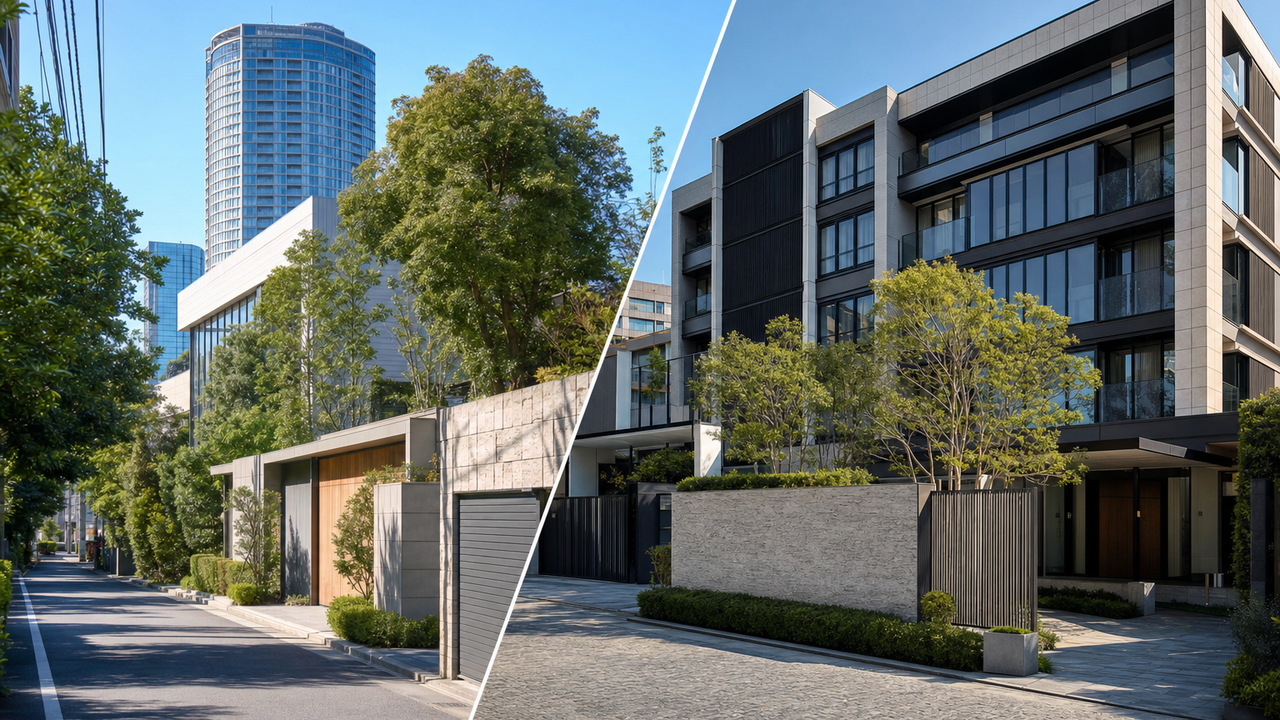
Choosing between Nishi-Azabu and Minami-Aoyama is one of the most common dilemmas facing high-income expat executives relocating to central Tokyo — both neighborhoods carry genuine prestige, yet they offer distinctly different lifestyles, rent structures, and daily rhythms. If you have narrowed your search to these two addresses and are still weighing the final decision, this guide is written specifically for you.
Both neighborhoods sit within Tokyo’s most sought-after residential corridor, attracting senior professionals at global firms, diplomats, and creative directors who value walkability, international community, and proximity to Shibuya or Roppongi. Yet the day-to-day experience of living in each area diverges more than most relocation guides acknowledge. Understanding exactly where those differences lie — in rent per square metre, street character, transport convenience, and social atmosphere — is what turns an expensive guess into a confident choice.
Who this article is for
- High-income expat executives comparing Nishi-Azabu and Minami-Aoyama as final-shortlist candidates
- Foreign professionals relocating to Tokyo for roles at multinational firms, embassies, or funded startups who need English-language guidance
- Couples or single professionals with annual incomes above ¥10 million who want to understand the real trade-offs before signing a lease
What you’ll learn
- How Nishi-Azabu and Minami-Aoyama compare across rent, lifestyle, transport, and international community
- Which profile of resident tends to thrive in each neighborhood — and why
- Practical guidance on navigating Tokyo’s rental market as a foreign national, including where to find bilingual support
Setting the Stage: Why These Two Neighborhoods Dominate the Expat Premium Market

Tokyo’s residential rental market spans dozens of distinct neighborhoods, yet Nishi-Azabu and Minami-Aoyama consistently appear at the top of shortlists for high-income foreign professionals. Understanding what drives that reputation — and where it is genuinely deserved versus overstated — is the essential first step before comparing the two in detail.
What Makes a Tokyo Address “Premium” for Expats
Premium expat addresses in Tokyo tend to share a cluster of attributes: low-rise residential streets free of heavy commercial traffic, proximity to either Roppongi or Aoyama-Dori for international dining and retail, access to international schools or clinics, and a critical mass of other foreign residents that makes daily life more navigable in English. Both Nishi-Azabu and Minami-Aoyama satisfy most of these criteria — which is precisely why they command the rent premiums they do.
That said, “premium” in Tokyo means something more specific than luxury finishes alone. The most experienced expat renters in this market consistently cite walkability to lifestyle infrastructure and neighbourhood atmosphere as the defining factors — not just the apartment itself. A ¥600,000-per-month apartment in an area with no English-speaking dry cleaner, no international supermarket within 15 minutes, and no sense of community often produces lower resident satisfaction than a ¥350,000 unit in a genuinely well-serviced neighbourhood.
Both Nishi-Azabu and Minami-Aoyama score well on infrastructure, but their atmospheres are meaningfully different. Nishi-Azabu leans residential and discreet; Minami-Aoyama leans cultural and visible. That distinction drives almost every other trade-off discussed in this article.
The Shibuya Commute Factor
For professionals working in or around Shibuya — the geographic anchor of Tokyo’s tech and startup ecosystem — both neighbourhoods sit within a practical commuting radius. Nishi-Azabu is typically accessed via the Hibiya Line at Hiroo Station or by taxi along National Route 246. Minami-Aoyama is served by the Ginza, Chiyoda, and Hanzomon Lines at Omotesando Station, one of Tokyo’s most well-connected interchange points.
Door-to-door commute times to Shibuya Station tend to run 12–20 minutes from Minami-Aoyama via Omotesando, and 18–30 minutes from Nishi-Azabu depending on whether you take a taxi, walk to Hiroo, or connect via Roppongi. For professionals at Google Japan or other Shibuya-area tech offices, this commute differential is worth factoring explicitly into the location decision.
Rent Context: What “Expensive” Actually Means Here
Both neighbourhoods regularly feature in Tokyo’s highest residential rent bands. As a general market tendency, well-appointed two-bedroom apartments (60–80 m²) in Minami-Aoyama and Nishi-Azabu are typically listed in the ¥300,000–¥600,000+ per month range, with larger luxury units and furnished expatriate-grade properties frequently exceeding those figures. These are indicative ranges based on general market observation; actual rent will vary substantially by building age, floor, amenities, and individual landlord terms.
It is important to note that Tokyo’s real estate market is subject to fluctuation, and neither neighbourhood can be assumed to hold or increase in rental value over any given period. Foreign nationals are advised to consult a specialist before making any financially significant housing commitment.
Nishi-Azabu vs Minami-Aoyama: Side-by-Side Comparison

The table below summarises the key dimensions that matter most to high-income expat professionals choosing between these two addresses. Each criterion is explored in greater depth in the neighbourhood-specific sections that follow.
| Criterion | Nishi-Azabu | Minami-Aoyama |
|---|---|---|
| Neighbourhood Character | Quiet, residential, discreet luxury | Cultural, design-forward, visible prestige |
| Typical 2BR Rent Range | ¥320,000–¥580,000+/month (indicative) | ¥350,000–¥650,000+/month (indicative) |
| Nearest Train Station | Hiroo (Hibiya Line) | Omotesando (Ginza / Chiyoda / Hanzomon) |
| Commute to Shibuya | ~18–30 min (via Hiroo or taxi) | ~12–20 min (via Omotesando) |
| International Expat Density | High — long-established diplomatic/exec community | High — creative/cultural international community |
| English-Language Services | Good — clinic, supermarket, concierge services | Good — retail, gallery, café staff often English-capable |
| Nightlife & Dining Proximity | Adjacent to Roppongi — very close | Aoyama-Dori corridor — upscale restaurant scene |
| Street-Level Noise | Generally quiet back streets | Varies — quieter on residential lanes, busier on Kotto-dori |
| Best Suited For | Executives valuing privacy, space, and Roppongi access | Professionals valuing culture, Shibuya commute, design scene |
| Foreign National Renting Ease | Moderate — bilingual agent recommended | Moderate — bilingual agent recommended |
NOTE
Rent figures in this table are indicative ranges based on general market observation as of 2026. The Tokyo residential rental market is subject to change, and actual rents depend on building specification, floor, furnishing, and landlord terms. Always verify current pricing with a licensed agent before making any financial commitment.
Nishi-Azabu in Depth: Quiet Prestige and Executive Privacy
Nishi-Azabu is the address many senior expat executives gravitate toward after they have lived in Tokyo long enough to know what they actually want. It is less immediately obvious than some neighbouring postcodes — there is no landmark railway station bearing its name — but that very quality is part of its appeal. For professionals who prioritise space, quiet, and proximity to Roppongi without the noise of Roppongi itself, Nishi-Azabu is difficult to beat.
The Physical Character of Nishi-Azabu
Nishi-Azabu occupies a grid of relatively quiet residential streets that run between Gaien-Higashi-dori to the east and the Azabu area to the south. The neighbourhood is characterised by a mix of older low-rise buildings, newer high-specification condominium towers, and gated residences that sit behind mature hedges and walls. The street-level atmosphere is decidedly calm — unlike neighbouring Roppongi, there is no club district or late-night foot traffic to contend with on most residential streets.
This physical character makes Nishi-Azabu particularly appealing to couples and senior executives who want to feel genuinely at home rather than on display. The apartments available here tend toward larger floor plans relative to central Tokyo norms — 80–150 m² units are more commonly available than in the more densely developed parts of Minami-Aoyama. For expats relocating with a significant volume of furniture, or simply preferring not to feel compressed by Tokyo’s typically modest apartment dimensions, that extra space is a meaningful advantage.
The Roppongi Adjacency: Asset or Liability?
Nishi-Azabu’s proximity to Roppongi is the single most polarising element of choosing this address. For professionals who value access to Tokyo Midtown, the National Art Center, international hotels, and Roppongi Hills’ retail and restaurant offerings, the five-to-ten-minute walk is an unambiguous asset. Roppongi concentrates a disproportionate share of Tokyo’s international infrastructure — foreign chambers of commerce events, English-language medical services, international restaurant diversity — and living immediately adjacent to it is genuinely convenient.
However, some residents find that Roppongi’s late-night reputation creates low-level noise or a less family-oriented street atmosphere on the eastern fringe of Nishi-Azabu. The practical solution adopted by most experienced expat residents is to choose an apartment on the western or central streets of Nishi-Azabu, where the area’s residential character is fully preserved.
Transport from Nishi-Azabu
Nishi-Azabu is one of the rare central Tokyo neighbourhoods that lacks a railway station directly within its boundaries — the nearest options are Hiroo Station (Hibiya Line, roughly 10–15 minutes on foot from the centre of the neighbourhood), Roppongi Station (Hibiya and Oedo Lines), and Azabu-Juban Station (Namboku and Oedo Lines). This means that most residents use taxis or rideshare services for short trips and rely on Hiroo or Roppongi for train access.
For Shibuya-bound commuters, the typical route involves walking or cycling to Hiroo and taking the Hibiya Line to Ebisu, then transferring — adding roughly 5–10 minutes compared to commuting from Minami-Aoyama’s Omotesando. This is not a significant inconvenience for executives whose companies provide transportation allowances, but it is worth noting for those who prefer a simpler, fully walkable commute.
| Pros of Nishi-Azabu | Cons of Nishi-Azabu |
|---|---|
|
|
- Senior executives and directors who prioritise privacy, space, and a quiet residential atmosphere
- Professionals whose primary social and professional hub is Roppongi or Tokyo Midtown
- Couples without children who want larger apartments and can walk or use taxis for most daily movement
- Diplomats and C-suite expats accustomed to a formal, discreet residential address
Minami-Aoyama in Depth: Cultural Cachet and Shibuya Connectivity

Minami-Aoyama carries a different kind of prestige than Nishi-Azabu — one rooted as much in cultural identity as in residential exclusivity. The neighbourhood is home to independent design studios, established art galleries, high-end concept stores on Kotto-dori (Antique Street), and some of Tokyo’s most respected restaurants. For expats who moved to Tokyo partly because of its reputation as a global design and culture capital, living in Minami-Aoyama is a daily affirmation of that choice.
The Cultural and Design Identity of Minami-Aoyama
Minami-Aoyama’s cultural identity is not incidental — it has been deliberately shaped over decades by the clustering of Japanese fashion houses, international gallery spaces, and independently owned lifestyle businesses along and between Aoyama-Dori and Kotto-dori. Residents wake up surrounded by the kind of considered aesthetic environment that most cities can only approximate.
This matters practically as well as aesthetically. The international residents drawn to Minami-Aoyama tend to include creative directors, brand strategists, architects, and senior figures in the fashion and media industries — alongside the tech executives and finance professionals who dominate Nishi-Azabu. The social community in Minami-Aoyama is therefore somewhat more culturally diverse in professional background, which many expats find stimulating and professionally valuable.
Omotesando Station and Transport Advantages
Minami-Aoyama’s most concrete practical advantage over Nishi-Azabu is Omotesando Station, which serves three metro lines — the Ginza, Chiyoda, and Hanzomon Lines. This makes it one of the most well-connected residential stations in central Tokyo, offering direct or near-direct routes to Shibuya, Shinjuku, Otemachi, and beyond without transfer penalties. For professionals whose work requires regular cross-city movement — meetings in Marunouchi in the morning, a client in Shibuya in the afternoon — this connectivity is a genuine quality-of-life advantage.
The walk to Omotesando from most of Minami-Aoyama’s residential streets takes between 5 and 15 minutes, making it a genuinely walkable station catchment. This puts Minami-Aoyama in a category alongside very few Tokyo neighbourhoods: the rare combination of high residential prestige with strong public transport access. Those interested in how different Tokyo rail lines compare for Shibuya commuters may find the Toyoko Line vs Den-en-toshi Line comparison guide a useful reference for understanding the broader transport network.
Street-Level Experience and Noise Variation
Minami-Aoyama is not uniformly quiet. The streets immediately bordering Aoyama-Dori and the Kotto-dori shopping stretch carry meaningful foot traffic and commercial activity during the day and into the evening. Residents on the immediate frontage of these main arteries should expect a more urban, active street-level environment. However, the neighbourhood’s residential back streets — particularly those to the south and west — are genuinely calm and low-traffic, comparable in atmosphere to the quieter parts of Nishi-Azabu.
The practical implication for apartment selection is that street position within Minami-Aoyama matters significantly. An apartment two blocks south of Aoyama-Dori can offer near-total residential quiet; an apartment directly on Kotto-dori will have a very different daily soundscape. Working with a bilingual agent who knows the specific microgeography of the neighbourhood is particularly valuable here.
| Pros of Minami-Aoyama | Cons of Minami-Aoyama |
|---|---|
|
|
- Professionals who commute to Shibuya frequently and want the shortest, most reliable route
- Expats in creative, design, fashion, or media industries who want to live inside Tokyo’s cultural scene
- Couples or individuals who prioritise walkability to high-quality dining and retail over apartment size
- Those who value being seen to live in an internationally recognised cultural address
Which Should You Choose? A Persona-Based Guide
The decision between Nishi-Azabu and Minami-Aoyama ultimately comes down to a small number of genuinely consequential trade-offs. Most of the professionals who contact us after comparing these two neighbourhoods find that once they think carefully about their actual daily patterns — rather than abstract neighbourhood prestige — a clear preference emerges.
Choose Nishi-Azabu if Your Priority is Space, Quiet, and Roppongi Access
If you are a senior executive whose social and professional calendar is anchored in Roppongi — client dinners at international hotels, events at Tokyo Midtown, meetings at embassies or international business clubs in the area — then Nishi-Azabu’s proximity to that hub is a tangible daily advantage. Add to that the neighbourhood’s generally larger available floor plans and genuinely residential atmosphere, and Nishi-Azabu makes a compelling case for executives who want their home to feel distinctly separate from their work environment.
Nishi-Azabu also tends to attract a more established, longer-tenure expat community — the kind of residents who have been in Tokyo for five or ten years, have navigated the rental market before, and have built stable local networks. For newly arrived executives relocating their families, there is real value in moving into a neighbourhood where other long-term expats can offer informal advice on everything from domestic help to children’s activities to trusted mechanics.
For those exploring how to identify the right residential area near their Shibuya-area office, the walkable Tokyo neighborhoods guide for tech workers offers a useful broader perspective on the Jonan corridor.
Choose Minami-Aoyama if Your Priority is Shibuya Connectivity and Cultural Vibrancy
If you commute to Shibuya three or more times per week, or if your Tokyo social life is oriented toward the Shibuya–Omotesando–Harajuku triangle, Minami-Aoyama is likely to produce measurably higher daily quality of life. The difference of five to ten minutes on every commute is small in isolation but accumulates meaningfully over weeks and months — and the reliability of Omotesando’s three-line station compared to Hiroo’s single line is an added benefit on days when one service is disrupted.
For expats who moved to Tokyo because of its reputation as a global creative capital and want their residential environment to reflect that identity, Minami-Aoyama is also simply more stimulating as a daily backdrop. Walking to work via the Omotesando boutique corridor, passing independent coffee roasters and concept stores, is a qualitatively different morning than navigating Nishi-Azabu’s quiet residential lanes — neither is objectively better, but they attract different temperaments.
POINT
For most high-income expat executives comparing these two neighbourhoods, the single most useful question to ask is: where do you spend your evenings? If the answer is Roppongi, choose Nishi-Azabu. If the answer is Shibuya and Omotesando, choose Minami-Aoyama.
The One Area Both Neighbourhoods Share: The Challenge of Renting as a Foreign National
Regardless of which neighbourhood you choose, the practical challenge of renting as a foreign national in either Nishi-Azabu or Minami-Aoyama is broadly similar — and it is a challenge that is frequently underestimated by professionals arriving from rental markets in New York, London, or Singapore.
Tokyo’s premium residential rental market involves Japanese-language contracts, guarantor requirements that are typically difficult for foreign nationals to fulfil through standard means, and landlords who — despite operating in internationally oriented neighbourhoods — may have limited experience with foreign tenants. The most effective solution, consistently reported by successful expat renters in both areas, is to work with a bilingual agent who has established relationships with landlords in the specific buildings you are targeting. A specialist with 25 years of central Tokyo experience, who can explain each clause in English and navigate the guarantor process on your behalf, routinely makes the difference between a smooth relocation and a month of frustrating failed applications.
Understanding how to work effectively with the Tokyo rental market as a foreign national is covered in depth in The Complete Foreigner’s Guide to Renting an Apartment in Tokyo, which provides practical guidance on the application process, guarantor options, and what to expect from Japanese tenancy agreements.
- Assuming your corporate guarantee automatically covers landlord requirements — many premium buildings have specific criteria that need case-by-case negotiation
- Relying solely on general property portals without bilingual support — listed prices do not always reflect final negotiated terms or total move-in costs
- Underestimating initial costs — key money (礼金), deposit (敷金), agency fees, and guarantor fees can push total move-in costs to 3–6 months of rent
- Choosing a unit on a main arterial road without verifying noise levels at the specific floor and time of day you will be home
Summary: Making Your Final Decision with Confidence
Nishi-Azabu and Minami-Aoyama are both genuinely exceptional residential addresses for high-income expat professionals in Tokyo — the debate between them is a privilege problem in the best sense. Both offer international communities, high-specification housing stock, English-language services, and proximity to Shibuya’s professional ecosystem. The decision between them is therefore properly a question of personal lifestyle fit rather than an objective quality ranking.
Nishi-Azabu is the better fit for executives who value privacy, larger living spaces, and a quiet residential atmosphere within easy reach of Roppongi. Minami-Aoyama suits professionals who commute frequently to Shibuya, value cultural and design stimulation in their daily environment, and are content with somewhat smaller floor plans in exchange for superior transport connectivity.
What both neighbourhoods share equally is the need for expert, bilingual guidance through Tokyo’s rental process. Tokyo’s best neighbourhoods guide provides a wider overview of where different lifestyle and budget profiles align across central Tokyo, which may be useful if you are still refining your search beyond these two options.
- High-income foreign nationals who need a bilingual consultant to manage the full rental process in Nishi-Azabu or Minami-Aoyama
- Expat executives who want to search central Tokyo properties by area and train line in English, then have a specialist confirm the details in Japanese
- Professionals who want the confidence of a real-estate consulting firm with 25 years of central Tokyo experience behind each recommendation
How the consultation process works
Frequently Asked Questions
Is Nishi-Azabu or Minami-Aoyama closer to Shibuya for daily commuters?
Minami-Aoyama is generally closer to Shibuya for daily commuters. Omotesando Station, which serves Minami-Aoyama, is on the Ginza, Chiyoda, and Hanzomon Lines, offering multiple direct routes to Shibuya in approximately 12–20 minutes. Nishi-Azabu relies primarily on Hiroo Station (Hibiya Line) and typically involves a longer overall journey of 18–30 minutes to Shibuya, depending on your exact address and whether you take a taxi to the station.
What is the typical rent for a two-bedroom apartment in these neighbourhoods?
As a general market observation in 2026, well-appointed two-bedroom apartments in both Nishi-Azabu and Minami-Aoyama are typically listed in the ¥300,000–¥650,000+ per month range, with luxury or furnished executive units often exceeding those figures. Exact rent depends on building age, floor, specification, furnishing status, and individual landlord terms. The Tokyo rental market is subject to fluctuation, and we recommend consulting a licensed bilingual agent for current pricing in specific buildings.
Can foreign nationals rent apartments in Nishi-Azabu or Minami-Aoyama without a Japanese guarantor?
It is possible, but it is not automatic. Many premium buildings in both neighbourhoods require a guarantor, and the requirements vary by landlord and building. Some buildings accept corporate guarantees from major international employers; others require a Japanese resident co-signer or a licensed guarantor company. Working with a bilingual agent who has established relationships with landlords in these specific areas significantly improves your chances of navigating this process successfully.
Which neighbourhood has a larger international expat community?
Both neighbourhoods have well-established international expat communities, though with different professional profiles. Nishi-Azabu and the wider Hiroo area have historically attracted diplomats, senior corporate executives, and long-tenure expats. Minami-Aoyama tends to draw a broader range of international professionals including those in creative industries, design, fashion, and media, alongside executives and finance professionals. Neither neighbourhood is objectively larger in expat density, but the social character of the community differs.
Are there English-speaking real estate agents who specialise in these two neighbourhoods?
Yes. Bilingual real estate specialists with central Tokyo expertise exist and are the recommended route for foreign nationals searching in premium neighbourhoods. A specialist with English capability and local market knowledge can search properties, explain lease terms in English, coordinate the guarantor process, and manage communication with landlords — removing the most common friction points that foreign professionals encounter when renting independently in Tokyo.