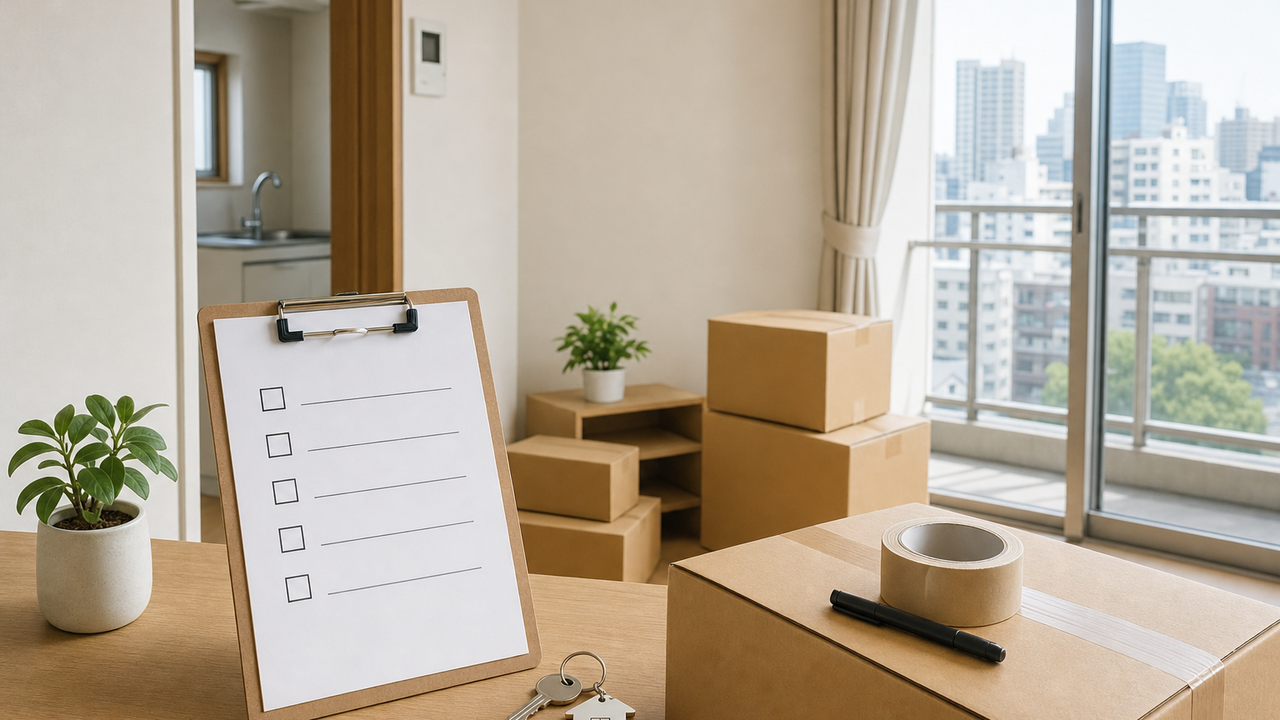
Moving to Tokyo as an expat is one of the most exciting decisions you’ll make — but it can also feel overwhelming the moment you start thinking about all the steps involved. From sorting out your visa paperwork before you board the plane, to figuring out how to open a Japanese bank account after you land, the process involves dozens of tasks that are easy to lose track of. And when you’re doing it all in a country where many official documents are still entirely in Japanese, even a small administrative misstep can cost you days of extra effort.
This guide is designed to cut through that confusion. Rather than vague advice, you’ll find a practical, phase-by-phase checklist covering everything from pre-departure preparations to settling into your new neighbourhood — including the parts that most expat guides overlook, like how to handle your jūminhyō (resident registration), which utilities require a Japanese guarantor, and why securing your apartment early is the single most time-sensitive step on the entire list.
Quick Answer: Moving to Tokyo Checklist for Expats (2026)
The essential steps are: (1) secure your visa and Certificate of Eligibility before departure; (2) start your apartment search from abroad using a bilingual agent; (3) register at your ward office within 14 days of arrival; (4) enrol in health insurance and pension; (5) apply for your My Number Card; (6) open a Japanese bank account; (7) set up utilities, a SIM card, and an IC transit card. Each step feeds into the next — resident registration unlocks banking, banking unlocks utility contracts, and so on. Use the phase-by-phase breakdown below to work through the list in the right order.
Who this article is for
- ●Foreign nationals relocating to Tokyo for work, especially those based near Shibuya or the Jonan area
- ●Expats who need English-language support to navigate Japan’s rental and administrative processes
- ●Anyone arriving in Tokyo for the first time and wanting a clear, step-by-step plan they can actually follow
What you’ll learn
- ●Exactly what to do before you leave your home country to make arrival smoother
- ●The critical administrative tasks to complete within your first 14 days in Japan
- ●How to set up utilities, banking, and everyday life — with tips specific to foreign residents
Before You Arrive: What to Sort Out in Your Home Country
The weeks before your departure are more important than most people realise. Getting these fundamentals right before you board will save you from scrambling to fix problems while jet-lagged and surrounded by boxes.
| Task | When to Do It | Why It Matters |
|---|---|---|
| Request Certificate of Eligibility (CoE) | As soon as job offer confirmed | Processing takes 4–8 weeks; everything else waits on this |
| Gather consulate documents | Simultaneously with CoE | Incomplete file = avoidable delays at visa appointment |
| Start apartment search with bilingual agent | 6–8 weeks before departure | Expat-friendly units are limited; early search avoids hotel stays |
| Book international shipping | At least 6 weeks before departure | Sea freight takes 4–8 weeks from most countries |
| Notify home bank; organise liquid funds | 2–4 weeks before departure | Initial rental costs (key money, deposits) often 3–6 months’ rent upfront |
| Arrange Japanese SIM or pocket Wi-Fi | Before or on arrival day | Internet access is essential from day one for navigation and admin |
Visa and documentation — start earlier than you think
Your visa category determines almost everything that follows: where you can live, whether you can open certain bank accounts, and what ID you’ll carry day to day. For most professionals relocating for work, the most common categories are the Engineer/Specialist in Humanities/International Services visa or the Highly Skilled Professional (HSP) visa. Both are sponsored by your employer in Japan, who will submit the Certificate of Eligibility (CoE) application on your behalf. Processing can take four to eight weeks, so request your CoE as soon as your job offer is confirmed.
While that’s in progress, gather the supporting documents you’ll need at the Japanese consulate or embassy in your home country: your passport (valid for at least six months beyond your intended stay), your employment contract, academic credentials, and passport-sized photographs. Check the specific requirements on the website of the Japanese diplomatic mission in your country, as they can differ slightly by location. Arriving at the consulate with an incomplete file is a common and avoidable delay.
Once your visa is issued, make certified copies of every document and store them separately from the originals — either in cloud storage or a carry-on bag. In Japan, you will reference your passport and residence card constantly in the first few months.
FIRST-HAND TIP
Many expats underestimate how much they’ll rely on physical documents in Japan. Even in 2026, ward offices and landlords routinely ask for paper copies of your residence card and passport. Keep a dedicated folder — physical and digital — with at least three certified copies of each key document. The few minutes this takes before departure saves hours of scrambling after arrival.
Starting your apartment search before you board
Securing housing is the most time-sensitive item on this entire checklist, and it is also the area where foreign nationals face the most friction. Many landlords in Japan still decline to rent to non-Japanese applicants, not out of explicit policy but due to language barriers and unfamiliarity with overseas credit histories. This means your pool of available properties is smaller, and competition for expat-friendly units is real.
The most practical approach is to begin your search while still abroad, using a bilingual rental service that specifically caters to foreign residents. Living in Jonan, backed by 25 years of experience as a real-estate consulting firm, works with foreign nationals at exactly this stage — letting you browse central Tokyo properties by area and train line online, communicate with bilingual consultants in English, and have your application prepared and submitted correctly the first time. Reaching out before you arrive means you may be able to sign a contract and have keys in hand on or shortly after landing, avoiding an expensive and inconvenient stay in a hotel or serviced apartment.
If you need to arrive before your permanent apartment is ready, budget for a short-term furnished rental or a weekly-rate guest house (ウィークリーマンション). Typical costs in central Tokyo in 2026 are in the range of ¥90,000–¥170,000 per month for a furnished studio in a desirable area, reflecting continued demand in the post-pandemic rental market, though prices vary considerably by ward and proximity to major stations.
Practical logistics: shipping, phones, and finances
International shipping to Japan is reliable but slow — sea freight typically takes four to eight weeks from major origin countries. If you plan to ship furniture or household goods, book your container or shared-shipment slot at least six weeks before departure. Air freight is faster but significantly more expensive per kilogram, so most expats use it only for essential items they’ll need immediately.
For mobile connectivity, purchase a Japanese SIM card or a pocket Wi-Fi router either at the airport or in advance online. In 2026, several carriers including IIJmio, LINEMO, and Rakuten Mobile offer plans with no Japanese address required at signup and English customer support via chat. Having internet access from day one is essential — you will use it for navigation, translation apps, and completing almost every administrative task on this list.
Notify your home-country bank of your move and check whether your debit card will work at Japanese ATMs. Japan remains significantly cash-based in many contexts — particularly for paying utility deposits, initial apartment fees, and smaller local businesses — so having reliable ATM access is practical from the first day. 7-Eleven and Japan Post ATMs accept most international cards and are the most reliable options. In 2026, IC card top-ups and some convenience store payments have expanded cashless options, but always carry ¥50,000–¥100,000 in cash for your first week.
CAUTION
The initial costs of renting an apartment in Tokyo can be substantial. Traditional contracts often include key money (礼金), a security deposit (敷金), agency fees, and advance rent — in some cases totalling three to six months’ rent upfront. Prepare this as liquid funds before you arrive, not as savings you plan to transfer after landing.
Your First Two Weeks: Administrative Priorities
The first fortnight in Japan is dense with paperwork, but the steps follow a logical sequence. Completing them in the right order avoids having to repeat visits to government offices.
| Day | Task | Documents Needed |
|---|---|---|
| Day 1–3 | Resident registration at ward office | Passport, Residence Card, lease agreement |
| Day 1–3 | Apply for My Number Card | Residence Card, passport photo |
| Day 3–7 | Enrol in National Health Insurance (if not on employer plan) | Residence Card, jūminhyō |
| Day 3–7 | Enrol in National Pension (if not on employer plan) | Residence Card, jūminhyō |
| Day 5–10 | Open Japanese bank account | Residence Card, jūminhyō, seal (hanko) or signature |
| Day 7–14 | Set up utilities (gas, electricity, water) | Lease, bank account details |
| Day 7–14 | Get IC transit card (Suica or Pasmo) | Cash or linked credit card |
Resident registration (住民登録) — your first stop
Registering as a resident at your local ward or city office is legally required within 14 days of establishing your address in Japan and is the step that unlocks almost everything else. You will need your passport, your Residence Card (在留カード, issued at the airport for most visa categories on arrival), and proof of your address — typically your lease agreement.
The ward office will register your address on your Residence Card and in the national resident database. From this moment, you can request your jūminhyō (住民票), a certified extract of your resident registration. This document functions as official proof of address in Japan and is required for opening a bank account, signing phone contracts, enrolling children in school, and dozens of other processes. Request at least two certified copies on your first visit — it saves return trips.
Ward offices are typically open Monday to Friday, 8:30 am to 5:00 pm, with some offering extended hours on certain weekdays or Saturdays. In areas with a high concentration of foreign residents — such as Shibuya, Minato, and Meguro wards — staff are increasingly accustomed to assisting non-Japanese speakers, and some offices provide multilingual forms and tablet-based translation support. Still, bringing a Japanese-speaking colleague or a translation app will make the visit significantly smoother.
FIRST-HAND TIP
Go to the ward office as early in the week and as early in the morning as possible — typically by 9:00 am on a Tuesday or Wednesday. Avoid Mondays (post-weekend backlog) and the last few days of the month. Meguro and Shibuya ward offices in particular have significantly shorter queues before 10:00 am. Budget 90 minutes for your first visit even if the actual process only takes 20 minutes.
National Health Insurance and pension enrollment
Most foreign residents in Japan who are not enrolled in their employer’s company health insurance (社会保険) are required to enrol in the National Health Insurance scheme (国民健康保険, or NHI). Enrollment is done at the same ward office and should be completed as soon as possible after resident registration, as premiums are calculated retroactively from your registration date.
NHI covers approximately 70% of medical costs for most procedures, with the patient paying the remaining 30% at the point of care. Monthly premiums vary based on your previous year’s income and your ward; for a mid-range salary earner in 2026, expect roughly ¥15,000–¥35,000 per month as a general guide, though the actual figure will be calculated by your ward office based on your specific situation. If your employer provides health insurance, you will be enrolled in that system instead and the above does not apply — confirm this with your HR team on or before your first day.
Pension enrollment (国民年金) follows the same process. Foreign residents working in Japan for more than six months are generally required to contribute. If you later leave Japan permanently, you may be eligible for a lump-sum withdrawal payment — keep this in mind and retain all your pension records and contribution statements.
My Number Card and why it matters in 2026
Japan’s national identity number system — known as My Number (マイナンバー) — is now deeply integrated into everyday administrative life. In 2026, the My Number Card (マイナンバーカード) has fully replaced the traditional health insurance card for most residents, serves as a valid photo ID for tax filings and government online services, and is increasingly accepted at convenience store kiosks for certificate printing (jūminhyō, etc.) without a separate trip to the ward office.
Apply for the card at your ward office at the same time as your resident registration. The card itself takes two to four weeks to arrive by post, but your My Number is assigned immediately and your employer will need it for payroll tax purposes from your first pay cycle. Once the card arrives, register it on the Maina Portal (マイナポータル) — this allows you to track health insurance status, view tax records, and access various government services digitally rather than in person. In 2026, the portal also integrates with some ward office services, reducing the need for in-person visits for routine certificate requests.
Finding and Securing Your Apartment

For most expats moving to Tokyo, securing the right apartment is simultaneously the most important and most stressful part of the whole process. Japan’s rental market has historically presented real barriers to foreign nationals, but the landscape has improved in 2026 — particularly for professionals working at well-known companies in central Tokyo, and for those who approach the process through a bilingual specialist agency.
Related articles / Related