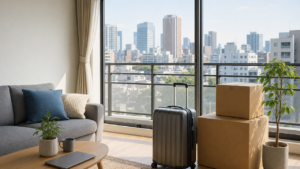
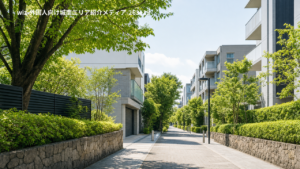
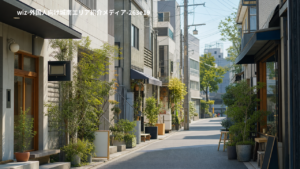
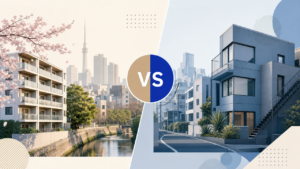
Finding a place to live in Tokyo as a foreigner is rarely straightforward — especially when you’re trying to decode a neighborhood’s real character from the outside. Nakameguro looks stunning on Instagram, but what is it actually like to live there day to day? And more practically: can you navigate the rental process without fluent Japanese?
This guide goes well beyond the tourist highlights. Whether you’ve just accepted a job offer near Shibuya and are scanning neighborhoods on your lunch break, or you’re weeks into a Tokyo apartment search that keeps hitting dead ends, you’ll find here the practical, honest information you need to decide whether Nakameguro fits your lifestyle — and your budget. Living in Jonan has helped hundreds of international professionals settle into central Tokyo, and this guide reflects that accumulated, ground-level expertise.
Who this article is for
- ●Foreign professionals working near Shibuya, Daikanyama, or Ebisu who are considering renting in Nakameguro
- ●English speakers who need clear, jargon-free guidance on the Tokyo rental process
- ●Relocating singles or couples without children looking for a walkable, design-conscious neighborhood
What you’ll learn
- ●The real living environment of Nakameguro: transport, amenities, noise levels, and community feel
- ●Honest rent ranges, typical apartment layouts, and what your budget actually gets you in 2026
- ●Step-by-step guidance on renting as a foreigner, including guarantor requirements and English-language support options
Nakameguro Living Guide for English Speakers: What You Need to Know First

Quick Answer: Nakameguro is one of central Tokyo’s most livable neighborhoods for English-speaking foreigners in 2026. It offers a 3-minute train ride to Shibuya, a walkable riverside lifestyle, a genuine international community, and access to English-friendly real estate agents. Monthly rent for a comfortable 1LDK starts around ¥160,000–¥210,000. The rental process is navigable without Japanese if you use a bilingual agency — and this guide walks you through every step.
Nakameguro consistently ranks among the most desirable neighborhoods in central Tokyo for international residents — not because it is flashy, but because it quietly delivers on almost every front that matters to a working professional: commute time, walkability, food culture, and a sense of community that feels lived-in rather than manufactured.
Transport: A Genuinely Short Commute
Nakameguro Station sits at one of Tokyo’s most strategically useful junctions: the Tokyu Toyoko Line and the Tokyo Metro Hibiya Line both pass through it. From the station, Shibuya is three minutes by train. Ebisu is two minutes. Daikanyama — one of the most popular neighborhoods for foreign residents — is reachable on foot in about eight minutes. This puts Nakameguro within easy cycling or walking range of a large arc of central Tokyo employment.
For tech workers at companies like Google, Amazon, ByteDance, or the many international startups clustered in the Shibuya-Daikanyama corridor, Nakameguro is effectively a five-to-fifteen minute door-to-office commute in most scenarios. The Hibiya Line also provides a single-transfer route to Roppongi, Toranomon, and Ginza — making it viable for professionals whose clients are spread across the city.
One practical note: Nakameguro Station itself is not enormous, which is an advantage. Rush hour is noticeably less overwhelming than at Shibuya or Shinjuku. The platforms are manageable, transfers are short, and the station is small enough that you learn its layout within a week.
Neighborhood Character: What It Feels Like to Actually Live Here
Nakameguro has an unusual quality among central Tokyo neighborhoods: it manages to feel genuinely local. Despite its international reputation — fueled by the Meguro River’s photogenic cherry blossom season and a steady stream of design press coverage — the residential streets behind the main boulevard retain a quiet, residential rhythm.
The area is loosely divided between the canal-side strip (high foot traffic, boutiques, restaurants, coffee roasters) and the surrounding residential blocks, which are calm, low-rise, and surprisingly quiet given the proximity to Shibuya. A typical evening in the residential lanes involves very little noise beyond the occasional bicycle or the distant sound of a convenience store jingle.
The international presence in Nakameguro is real but not overwhelming. You’ll find a meaningful number of foreign residents, particularly among creative professionals, designers, and tech workers. English is spoken at many of the area’s cafés, restaurants, and independent shops without any awkwardness. The neighborhood has absorbed a cosmopolitan identity without losing its local character — which, for many foreign professionals, is exactly the balance they’re looking for.
As of 2026, Nakameguro’s international community has grown further, partly driven by the continued expansion of Tokyo-based tech offices and global creative firms. New English-friendly businesses — from specialty fitness studios to bilingual co-working spaces — have opened along and near the river strip, making the neighborhood more foreigner-accessible than ever without feeling like an expat bubble.
Safety and Noise Environment
Nakameguro scores strongly on safety by any measure commonly used for Tokyo residential areas. The ward (Meguro-ku) consistently records low crime rates relative to central Tokyo norms. Streets are well-lit, and the mix of residential and commercial use means there is natural foot traffic at most hours without the nightlife-driven disruption you’d encounter in Shimokitazawa or certain corners of Shinjuku.
Noise is worth discussing honestly. The Meguro River canal strip — particularly the blocks immediately adjacent to the water between Nakameguro Station and the Daikanyama end — generates meaningful pedestrian noise on weekend evenings, especially in spring. If you are considering an apartment within one block of the canal, visit on a Saturday night in addition to your weekday viewing. Apartments set back from the river by even two or three residential blocks are considerably quieter and in many cases more affordable.
English-Friendliness: Day-to-Day Practicalities
For English speakers specifically, Nakameguro is one of the easier Tokyo neighborhoods to navigate without Japanese. Beyond restaurants and cafés, the local ward office (Meguro City Hall) has English-language services for resident registration and municipal procedures. Several local medical clinics near the station have English-speaking staff or phone interpretation services. Larger supermarkets stock imported goods and have staff accustomed to helping foreign residents. The area’s density of internationally oriented businesses means that basic daily life — grocery runs, picking up a package, asking directions — rarely requires more than basic communication.
Rent, Apartment Types, and What Your Budget Gets You in 2026

Nakameguro is not the cheapest neighborhood in central Tokyo, and it would be misleading to suggest otherwise. But it is considerably more approachable than Minami-Aoyama or Hiroo, and the lifestyle return on rent investment is high. Understanding the real cost breakdown — not just the headline rent figure — is essential before you begin viewings.
2026 Rent Ranges at a Glance
| Apartment Type | Typical Size | Monthly Rent Range | Best For |
|---|---|---|---|
| 1K | 20–30 m² | ¥100,000–¥140,000 | Budget-conscious singles |
| 1DK | 30–40 m² | ¥130,000–¥170,000 | Singles who work from home occasionally |
| 1LDK | 40–55 m² | ¥160,000–¥210,000 | Singles or couples, comfortable minimum |
| 2LDK | 55–75 m² | ¥220,000–¥310,000 | Couples, dedicated home office |
| 3LDK+ | 75 m²+ | ¥320,000+ | Families, executives with housing allowance |
Rent ranges reflect mid-tier buildings within 10 minutes’ walk of Nakameguro Station as of mid-2026. River-view units and newly built properties command a premium of 10–20% above these figures.
Understanding the Initial Costs Beyond Monthly Rent
The sticker shock for most foreign residents in Tokyo is not the monthly rent — it’s the move-in package. Japan’s rental market traditionally bundles several upfront costs, and while reforms have made the market more transparent in recent years, you should budget for the following when calculating your total initial outlay.
Security deposit (shikikin): Typically one to two months’ rent, held against damage and returned (partially or in full) upon departure. Some newer or foreign-resident-friendly properties have reduced this to one month. Key money (reikin): A non-refundable gift to the landlord, still present in some older or landlord-managed properties, though increasingly rare in buildings targeting international tenants. Confirm explicitly before proceeding. Agency fee: Generally one month’s rent plus tax, paid to the real estate agency. Guarantor fee and insurance: Most properties require a rent guarantor company (hoshō gaisha), which charges an initial fee and an annual renewal fee — typically calculated as a percentage of monthly rent.
In practical terms, expect to pay the equivalent of three to five months’ rent as your total move-in cost. This is significant, but it is standard across central Tokyo. The variation lies in the details: which costs are negotiable, which building types require key money, and which guarantor companies will accept foreign residents without a Japanese co-signer. These are exactly the questions where English-speaking guidance makes the largest practical difference.
Apartment Types: What the Layout Labels Mean
Japanese apartment listings use a consistent shorthand that can be confusing at first. 1K means one room plus a separate kitchen area — typically the entry-level option for singles. 1DK adds a combined dining-kitchen space; 1LDK has a living-dining-kitchen integrated area plus one bedroom. These are meaningfully different in terms of how the space actually feels and functions for someone working from home part of the week.
For a single professional accustomed to European or North American apartment sizes, a 1LDK in the 40–55 m² range in Nakameguro is generally the comfortable minimum. This gives you a proper separation between sleeping and living space. At this size and in this neighborhood, you are looking at monthly rents in the ¥160,000–¥210,000 range for a mid-tier building — higher for newer construction or views of the Meguro River. Couples comfortable with Tokyo-scale living often find a 1LDK or compact 2LDK workable, particularly if both partners commute out of the apartment most of the day.
Hidden Value: Where Nakameguro Overdelivers
Several aspects of Nakameguro’s living proposition are not captured in the rent figure. The density of high-quality food and coffee within walking distance means residents genuinely spend less time and money commuting to good meals. The river walking path is effectively free daily infrastructure for exercise and decompression. The neighborhood’s scale — compact enough to learn quickly — reduces the cognitive overhead that comes with living somewhere sprawling and anonymous.
For professionals at international companies whose employers may offer housing allowances (a common benefit at large tech employers operating in Japan), Nakameguro sits at a rent level that typically qualifies. If your employer provides a housing stipend of ¥100,000–¥150,000 per month, your personal outlay for a comfortable 1LDK becomes very manageable at Tokyo salary levels.
How to Rent an Apartment in Nakameguro as a Foreigner: Step by Step

The Tokyo rental process follows a fairly predictable sequence, but each stage contains decision points where language barriers and unfamiliarity with local customs create real friction for foreign residents. What follows is an honest walkthrough of the process as it actually works in 2026 — including the stages that often surprise people.
Step 1: Define Your Requirements Before You Start Searching
Before contacting any agency, be clear on three things: your maximum monthly rent (including utilities), your required move-in date, and your visa/employment situation. Having these details ready allows a bilingual consultant to immediately filter listings to what you can realistically apply for — rather than wasting viewings on properties where your application will be rejected at the guarantor stage.
Step 2: Document Requirements for Foreign Residents
Foreign nationals renting in Japan need to assemble a specific set of documents, and missing even one can delay or derail an application. The standard requirements are: a valid residence card (zairyu card), your employment contract or letter of employment (ideally stating your annual income in Japanese or with certified translation), recent pay slips — typically the past three months — and your My Number (individual number card) if you have one. Passport copies are often requested alongside the residence card.
The income threshold that landlords and guarantor companies typically apply is that your monthly rent should not exceed roughly 33% of your gross monthly income. For a ¥180,000/month apartment, this means a demonstrable annual income of approximately ¥6.5 million or more. For the income levels typical of international tech workers in Shibuya-area companies, this threshold is usually comfortably met — but you need the documentation to prove it, and it must be presented in a way that a Japanese guarantor company can process efficiently.
Visa type also matters. Permanent residents and long-term visa holders (engineer/specialist in humanities/international services, intra-company transferee, etc.) face fewer obstacles. Short-term or student visa holders face significantly more scrutiny and may be declined by a higher proportion of properties. If your visa status is in any way non-standard, discussing it openly with a bilingual consultant before beginning your search will save you from submitting applications that are likely to be declined.
Step 3: The Guarantor Requirement — What It Actually Means
Japan’s rental market has historically required a personal guarantor — traditionally a family member with Japanese permanent residency or citizenship. For foreign residents without Japanese family connections, this was a significant barrier. The solution that now dominates the market is the rent guarantor company (hoshō gaisha), which acts as a professional guarantor for a fee.
Most properties in Nakameguro and central Tokyo now accept, and many require, guarantor company coverage. You select from a panel of companies approved by the landlord, pay an initial premium (commonly 50–100% of one month’s rent), and then an annual renewal fee. The guarantor company conducts its own creditworthiness assessment, which for foreign residents centers on your visa status, income documentation, and employment stability. Some guarantor companies are more accommodating of foreign applicants than others — and a knowledgeable agency will steer your application toward the companies most likely to approve your profile.
Step 4: Viewings — What to Check in Person
When viewing apartments in Nakameguro, prioritize these checks beyond the standard layout inspection: mobile signal strength inside the apartment (some older concrete buildings have poor reception); water pressure in the shower; proximity to the nearest convenience store and supermarket; and — if the unit is within two blocks of the Meguro River — noise levels at different times of day. Ask your agent specifically which direction the unit faces: south-facing units in Nakameguro’s low-rise residential blocks get meaningful natural light; north-facing units in narrow lanes can feel dim year-round.
Step 5: The Lease Contract — What to Check Before Signing
Japanese residential leases are lengthy documents and are almost always written in Japanese. You are legally bound by the contents regardless of your Japanese reading ability. Key sections to have explained to you in English before signing include: the restoration clause (genjo kaifuku — specifying what you are liable for upon departure), any restrictions on subletting or guests, the penalty clause for early contract termination, and the notice period required before moving out (typically one to two months). A bilingual agent will walk through these points with you; if yours does not offer to do this, ask explicitly.
One important distinction to confirm: whether your contract is a standard lease (futsū chintai) or a fixed-term lease (teiki chintai). Fixed-term leases have a set end date and cannot be renewed on the same terms — this matters significantly if you anticipate staying in the property for more than two or three years.