Google Japan’s Shibuya Office and the Commute Question Every Expat Asks

Landing a role at Google Japan is one thing. Figuring out where to actually live in Tokyo is a completely different challenge — and one that catches many newly arrived tech professionals off guard. The city is vast, the rail network is intricate, and the neighbourhoods that look appealing on Google Maps can feel very different once you’re standing on the street at 7 a.m. with a laptop bag on your shoulder.
Google Japan’s headquarters sits in Shibuya Stream, right beside Shibuya Station — one of the busiest and most well-connected transit hubs in Asia. That central position opens up a surprisingly wide radius of liveable neighbourhoods, each with its own character, rent range, and trade-off between commute time and lifestyle quality. The question is not simply “how close can I get?” but “what kind of life do I want to build around my work?”
Who this article is for
- ●Foreign professionals joining Google Japan or a tech company near Shibuya who need to find a home before their start date
- ●Expats relocating from overseas who want honest, practical neighbourhood comparisons rather than tourist-guide generalisations
- ●High-income renters looking for English-speaking real estate support to navigate Tokyo’s documentation-heavy rental process
What you’ll learn
- ●Which Tokyo neighbourhoods are consistently popular among tech professionals working near Shibuya, and why
- ●How commute time, rent level, and lifestyle trade-offs differ across the Jonan area and surrounding districts
- ●How to approach the Tokyo rental market with confidence as a foreign national, even without Japanese language skills
Why Neighbourhood Choice Matters More Than You Expect

For most expats arriving at a major tech company, the onboarding calendar is packed and the housing search gets compressed into a few frantic days. That pressure leads to a common mistake: choosing a neighbourhood based purely on commute time, without accounting for the lifestyle factors that will shape daily wellbeing for the next two or three years.
The real cost of an “optimal commute” neighbourhood
Neighbourhoods that sit directly on the Yamanote Line or within a single stop of Shibuya tend to carry a significant rent premium. A one-bedroom apartment in Ebisu or Daikanyama, for instance, can easily run 30–50% higher than a comparable unit in Nakameguro or Sangenjaya. Over a two-year contract, that difference compounds into a substantial sum — money that could go toward travel, savings, or simply a more comfortable apartment in a slightly less central location.
The Tokyo rail network is also more redundant than most newcomers realise. Many neighbourhoods that appear “far” on a map are actually reachable from Shibuya in fifteen to twenty minutes via two or three different lines. Understanding those alternatives is part of making a genuinely informed choice.
Why the Jonan area keeps attracting tech professionals
The Jonan area — broadly covering Shinagawa, Meguro, Ota, and Setagaya wards — has emerged as a consistently popular residential zone for foreign tech workers based in Shibuya. The reasons are structural. These wards sit directly south and southwest of Shibuya, are served by multiple rail lines, and offer a mix of urban convenience and residential calm that is harder to find in the immediate Shibuya vicinity. Rent levels are generally more competitive than Minato or Shibuya wards, while access to international supermarkets, English-speaking clinics, and bilingual schools remains reasonably strong.
Quality of street life also plays a role. Many Jonan neighbourhoods have preserved low-rise residential streets, small parks, and independent cafés alongside the standard convenience stores and chain restaurants. For professionals who spend long hours in open-plan tech offices, coming home to a neighbourhood with some human scale can matter more than it initially seems.
What Shibuya’s transit network actually enables
Shibuya Station connects eight rail lines, including the JR Yamanote, the Tokyu Toyoko and Den-en-toshi lines, the Keio Inokashira Line, and the Tokyo Metro Ginza, Fukutoshin, Hanzomon, and Hibiya lines. This density of connections means that almost any neighbourhood in the southern arc of Tokyo — from Jiyugaoka in the southwest to Nakameguro in the south — is accessible in under thirty minutes with at most one transfer. Understanding this is the key to expanding your search area beyond the obvious clusters near the office.
Neighbourhood Profiles: Where Tech Expats Tend to Land

The following areas consistently appear in conversations with foreign professionals working in the Shibuya tech corridor. Each has a distinct personality, and none is objectively “best” — the right fit depends on your priorities, household size, and lifestyle preferences.
Nakameguro and Meguro: the creative professional’s base
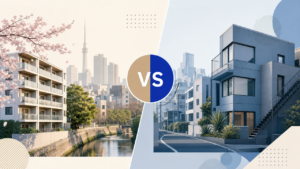
Nakameguro sits on the Tokyu Toyoko Line and Tokyo Metro Hibiya Line, putting Shibuya approximately six to eight minutes away by train. The neighbourhood is probably best known internationally for the canal-side cherry blossom season, but its daily character is defined by independent boutiques, specialty coffee shops, and a lively restaurant scene that draws creative and tech professionals year-round.
Apartments in Nakameguro tend to be older and smaller than their price points might suggest — you are paying partly for location and atmosphere. A one-bedroom unit in a newer building typically ranges from ¥150,000 to ¥230,000 per month, though prices vary considerably based on building age and exact address. Meguro Station, a short walk from Nakameguro, adds Tokyu Meguro Line access (connecting to Mita Line and Namboku Line), which is useful for anyone with a secondary commute destination.
For foreign nationals, one practical advantage of this area is its established expat community. English-speaking residents are not unusual, and several real estate agencies with bilingual staff operate locally — though navigating the documentation requirements for rental applications still benefits from dedicated professional support. Living in Jonan’s bilingual consultants cover this area and can walk you through the process from initial search to contract signing.
- ●Shibuya in 6–8 minutes on Tokyu Toyoko or Hibiya Line
- ●Established international dining, café, and lifestyle scene
- ●Rent premium for atmosphere — value-for-space is moderate
- ●Strong weekend foot traffic; quieter residential streets one block off the canal
Sangenjaya and Setagaya: value, community, and space
Sangenjaya — locally known as “Sancha” — represents one of the best overall value propositions for tech professionals who prioritise liveable space over proximity to Shibuya. The neighbourhood sits on the Tokyu Den-en-toshi Line, with Shibuya approximately nine to twelve minutes away, and on the Setagaya Line, a narrow above-ground tram that connects the local area in a way that feels unlike anywhere else in Tokyo.
Rent in Sangenjaya is generally 15–25% lower than comparable addresses in Nakameguro, which translates directly into access to larger apartments. A two-bedroom unit that would be financially difficult in Daikanyama becomes genuinely feasible here. The area has a strong local commercial strip around the station and a reputation for being slightly more lived-in and less curated than its eastward neighbours — which many residents find refreshing after the polish of the Shibuya zone itself.
The expat community in Sangenjaya is smaller than in some other areas, but it is active and growing. Several international residents note that the neighbourhood rewards investment in local relationships; it is the kind of place where you learn the shopkeeper’s name. For professionals who spend the working week in a large multinational tech environment, that texture can be a genuine asset.
Jiyugaoka and Midorigaoka: calm, European, and deeply residential
Jiyugaoka sits at the junction of the Tokyu Toyoko and Tokyu Oimachi lines, putting Shibuya approximately twenty minutes away with one transfer in most cases. The neighbourhood has a well-established reputation for European-influenced cafés, patisseries, and a shopping street architecture that feels decidedly un-Tokyo in the best possible sense. It is calm, walkable, and genuinely family-friendly without feeling suburban in a disconnected way.
For single professionals, Jiyugaoka makes sense if the twenty-minute commute is acceptable and the neighbourhood atmosphere genuinely appeals. For couples or for professionals who value having a clear separation between work life and home environment, it is frequently cited as one of the most satisfying long-term choices in the southern Tokyo arc. International supermarkets, including National Azabu at a short transit distance, help ease the adjustment for newly arrived foreign residents.
Comparing the Options: A Practical Overview

The table below summarises key factors across the most commonly considered neighbourhoods for tech professionals working near Shibuya. Rent figures are indicative ranges for a one-bedroom apartment in a modern building as of 2026; actual prices vary based on building age, floor, and exact location.
| Neighbourhood | Approx. Commute to Shibuya | 1BR Rent Range (monthly) | Best For | Trade-Off |
|---|---|---|---|---|
| Nakameguro | 6–8 min (direct) | ¥150,000 – ¥230,000 | Creative lifestyle, restaurant access | Lower space per yen |
| Daikanyama | 5–7 min (direct or walk) | ¥180,000 – ¥280,000 | Design-conscious professionals | Highest rent in the zone |
| Sangenjaya | 9–12 min (direct) | ¥110,000 – ¥180,000 | Space, value, community feel | Fewer English-language services |
| Jiyugaoka | 18–22 min (1 transfer) | ¥120,000 – ¥200,000 | Calm, residential, couples | Longer commute; transfer required |
| Shimokitazawa | 4–6 min (Keio Inokashira) | ¥100,000 – ¥165,000 | Arts, music, independent culture | Narrow streets; fewer large apartments |
| Meguro (station area) | 10–14 min (Meguro Line or walk to Nakameguro) | ¥130,000 – ¥210,000 | Multi-line access, balanced lifestyle | Less distinctive character vs. nearby areas |
INFO
Rent figures above are indicative ranges for 2026 based on general market conditions. Actual prices vary significantly based on building age, exact floor, furnishing, and proximity to the station. Always verify current listings directly — bilingual support can help you interpret market data accurately.
The Hidden Obstacles in Tokyo’s Rental Market for Foreign Nationals
Even after settling on a neighbourhood, foreign professionals routinely encounter friction in Tokyo’s rental market that their Japanese colleagues simply do not face. Understanding these obstacles in advance — and having the right support in place — is the difference between a smooth move and a month of frustrating rejections.
The guarantor and documentation challenge
Most standard rental applications in Japan require a guarantor — historically a Japanese national willing to co-sign liability for the lease. Foreign nationals without an established local network have traditionally struggled at this step, and some landlords remain reluctant to rent to applicants who cannot provide one. The market has evolved: corporate guarantee services (hoshō gaisha) now fill most of this gap, and many buildings that cater to international tenants will accept institutional guarantors in lieu of personal ones. However, the process varies by building and management company, and navigating it without Japanese language skills is difficult.
Income documentation requirements can also create unexpected friction. Japanese landlords typically want to see proof of annual income at a level of 36 times the monthly rent — meaning a ¥200,000 apartment requires documented income of approximately ¥7.2 million per year. For foreign professionals on global salary structures, translating international pay stubs into a format that Japanese landlords recognise is a practical task that benefits from experienced guidance.
Lease terms that differ from Western norms
Tokyo rental contracts contain several clauses that are standard locally but unfamiliar to most expats. Reikin (key money) — a non-refundable payment to the landlord, typically equivalent to one to two months’ rent — is less common than it was a decade ago but still appears in certain buildings and neighbourhoods. Renewal fees, typically charged at the end of each two-year lease term, are also standard in many contracts. Understanding what you are agreeing to before signing is essential, and this requires either strong Japanese reading ability or a qualified interpreter.
Move-out conditions are another area where misunderstandings are common. Japanese rental law distinguishes between tenant-caused deterioration (tenant’s responsibility to restore) and normal wear and tear (landlord’s responsibility). Disputes at move-out are not unusual, and the contract language governing this is almost always in Japanese.
Landlord reluctance and how to address it
A meaningful proportion of Tokyo landlords — particularly private individual owners of older buildings — prefer Japanese tenants, primarily because of perceived communication barriers and uncertainty about contract terms. This is a documented pattern, not conjecture, and it affects the practical range of apartments available to foreign applicants even when finances are not an issue.
The most effective counter to this is working with an agency that has pre-existing relationships with landlords who are comfortable with international tenants, and that can communicate on your behalf throughout the process. This is not just a convenience — it materially expands the range of properties accessible to you.
- ●Signing a contract without understanding the renewal fee clause — costs can accumulate significantly over a multi-year stay
- ●Underestimating move-in costs: initial payments (deposit, key money if applicable, agency fee, first month’s rent) can total four to six months’ rent
- ●Choosing an apartment based on photos alone — layout, natural light, and street noise need in-person assessment
- ●Not confirming whether the building accepts foreign national applicants before investing time in a viewing
- ●Assuming a short-term corporate housing experience reflects the long-term private rental market
Choosing Between Neighbourhoods: A Framework for Your Priorities
Rather than prescribing a single “best” neighbourhood, the more useful approach is to map your actual priorities against what each area offers. The following framework draws on the experiences of foreign professionals who have gone through this process — it is designed to narrow the field quickly rather than extend it.
If minimising commute time is the primary goal
Daikanyama and Ebisu sit within a genuinely walkable distance from Shibuya Stream on days when you want to avoid the train entirely, and each offers excellent lifestyle amenities. The trade-off is rent: you will pay a significant premium per square metre compared to areas five to ten minutes further out. If your housing budget is generous and you value the option of walking to work, this zone is worth the cost. If budget is tighter, the Nakameguro–Meguro corridor offers a comparable commute time at somewhat lower prices, though the gap has narrowed in recent years.
Shimokitazawa, easily overlooked by newcomers, is actually only four to six minutes from Shibuya on the Keio Inokashira Line. Its bohemian reputation and dense network of vintage shops and live music venues make it a strong fit for professionals with an arts-adjacent social life. Apartments are generally smaller and older, but the price-to-commute ratio is among the best in the zone.
If space and value are the priority
Sangenjaya is the most frequently recommended area for professionals who want a genuine apartment — one where you can have guests, set up a home office, and not feel that the walls are closing in — at a reasonable price. The Tokyu Den-en-toshi Line is fast and reliable, and the journey to Shibuya stays under twelve minutes in normal conditions. The neighbourhood’s slightly rougher-around-the-edges character is a feature rather than a flaw for many residents; it means fewer of the weekend crowds that descend on Nakameguro and Daikanyama.
Yoga and Komazawa, further along the Den-en-toshi Line, offer even better value per square metre with commutes still under twenty minutes. Both are largely residential with quieter commercial strips — better suited to professionals who socialise mainly inside the city centre rather than in their immediate neighbourhood.
If long-term stability and family considerations matter
Jiyugaoka and the Oimachi Line corridor — including Hatanodai and Nakanobu — tend to attract professionals thinking in terms of two to three year commitments, especially couples. The neighbourhood stock is generally of good quality, the environment is calm, and access to international schools (notably within reasonable reach of several international school campuses in the Meguro and Shinagawa area) is a consideration that many families weigh explicitly.
Setagaya ward more broadly — encompassing Sangenjaya, Shimokitazawa, and extending into Yoga, Chitose-Karasuyama, and Soshigaya-Okura — has a well-established reputation as a residential ward that balances urban access with liveable scale. For foreign professionals building a genuine life in Tokyo rather than passing through, this ward is worth exploring seriously.
- ●Professionals on a two-year or longer contract who want to establish a genuine home base rather than treating Tokyo as temporary
- ●Couples or individuals who want space for a home office and guest capacity without paying Minato ward prices
- ●Foreign nationals who value having English-speaking support for the rental process rather than navigating Japanese documentation independently
How Living in Jonan Can Help You Find the Right Home
The Tokyo rental market functions well for those who know how to navigate it — and creates real barriers for those who do not. For foreign professionals arriving under time pressure, the gap between “I know what neighbourhood I want” and “I have signed a lease on a great apartment” involves a series of documentation requirements, landlord negotiations, and contract clauses that are genuinely difficult to manage without Japanese language skills and local knowledge.
Living in Jonan is a bilingual real estate consulting service built specifically to bridge this gap. With 25 years of experience operating as a real estate consulting firm in central Tokyo, the service offers foreign residents the ability to search properties online by area and rail line, then work directly with a bilingual consultant who can manage the application, negotiation, and contract process in English. The goal is not just to find a property — it is to find the right property with confidence, avoiding the documentation pitfalls and landlord mismatches that derail many expat housing searches.
If you are moving to a tech company near Shibuya and want to approach your neighbourhood search with the same rigour you bring to your professional work, speaking with a Living in Jonan consultant early in the process is a practical first step. The service covers the Jonan area and central Tokyo broadly, with particular depth in the Meguro, Shinagawa, Setagaya, and Ota ward corridor — exactly the zone that tends to work best for Shibuya-based professionals.
Summary: Making a Confident Choice
Choosing where to live near Google Japan’s Shibuya office is not a question with a single correct answer. The neighbourhoods that work best for tech professionals in this corridor — Nakameguro, Sangenjaya, Daikanyama, Jiyugaoka, Shimokitazawa, and the broader Jonan area — each offer a distinct combination of commute time, rent level, lifestyle character, and practical livability. The right choice depends on what you value most, and on what you are willing to trade off to get it.
What is consistent across almost all successful expat housing searches in Tokyo is this: having bilingual support at the key stages of the process — property shortlisting, application, and contract review — substantially increases both the quality of the outcome and the speed of getting there. The Tokyo rental market is not hostile to foreign nationals, but it is structured in ways that reward local knowledge and professional relationships.
- ●A foreign professional working near Shibuya who needs English-speaking real estate support
- ●Looking for a home in the Meguro, Setagaya, Shinagawa, or Ota ward area
- ●Seeking a reliable, experienced partner to navigate documentation, guarantor requirements, and lease terms
About the service
Frequently Asked Questions
Q: What are the most convenient neighbourhoods for someone working at Google Japan in Shibuya?
A: The most commonly recommended areas for tech professionals working near Shibuya include Nakameguro, Daikanyama, Sangenjaya, and Shimokitazawa — all reachable within six to twelve minutes by train. The broader Jonan area (Meguro, Shinagawa, Setagaya, Ota wards) is also popular for its combination of transit access and liveable residential character.
Q: How much should a foreign professional budget for rent near Shibuya?
A: A one-bedroom apartment in a modern building within a twenty-minute commute of Shibuya typically ranges from ¥110,000 to ¥280,000 per month, depending on the neighbourhood and building quality. Areas like Sangenjaya and Shimokitazawa tend toward the lower end of that range; Daikanyama and Ebisu tend toward the higher end. Initial move-in costs (deposit, agency fee, first month’s rent) can equal four to six months’ rent.
Q: Can foreign nationals rent an apartment in Tokyo without a Japanese guarantor?
A: Yes — the market has evolved significantly. Most modern buildings accept institutional guarantor companies (hoshō gaisha) in place of a personal Japanese guarantor. However, some older buildings or private landlords may still prefer a Japanese national guarantor. Working with a bilingual agency that has established landlord relationships helps ensure you are introduced to properties where foreign national applicants are welcome.
Q: Is it possible to search for Tokyo apartments in English before arriving in Japan?
A: It is possible to browse listings remotely, and some agencies offer video viewings for candidates who have not yet arrived. However, the most effective searches generally involve at least one in-person visit to shortlisted apartments. Services like Living in Jonan allow you to begin the search online and then work with a bilingual consultant who can coordinate viewings and manage the application process efficiently once you are in Tokyo.
Q: What is the Jonan area and why do tech expats tend to gravitate toward it?
A: The Jonan area broadly covers Shinagawa, Meguro, Ota, and Setagaya wards — the southern and southwestern arc of central Tokyo. It appeals to tech professionals based in Shibuya because it sits directly along the Tokyu rail network that feeds into Shibuya Station, offers a mix of urban convenience and residential calm, and generally provides better value per square metre than Minato or Shibuya ward addresses at comparable commute distances.
Learn more about how we can help.
Bilingual consultants guide you so foreign residents can find a home with confid